


Page 446 - Marks Calculation for Machine Design
P. 446
P2: Sanjay
        P1: Shibu/Rakesh
                          January 4, 2005
                                      15:34
        Brown.cls
                 Brown˙C10
                  428
                                           APPLICATION TO MACHINES
                    Any number of spur-type gears on any number of fixed parallel shafts can be approached
                  using this fundamental principle that the velocity of the contact points between any two
                  gears must be the same from each gear’s perspective.
                  10.3.2 Planetary Gears
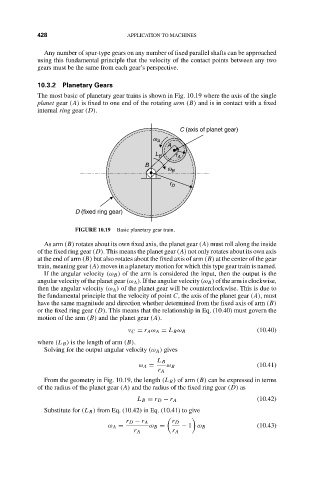
                  The most basic of planetary gear trains is shown in Fig. 10.19 where the axis of the single
                  planet gear (A) is fixed to one end of the rotating arm (B) and is in contact with a fixed
                  internal ring gear (D).
                                                         C (axis of planet gear)
                                                  w A
                                                     A
                                                  L B   r A
                                               B
                                                     w B
                                                      r D


                             D (fixed ring gear)

                             FIGURE 10.19  Basic planetary gear train.
                    As arm (B) rotates about its own fixed axis, the planet gear (A) must roll along the inside
                  of the fixed ring gear (D). This means the planet gear (A) not only rotates about its own axis
                  at the end of arm (B) but also rotates about the fixed axis of arm (B) at the center of the gear
                  train, meaning gear (A) moves in a planetary motion for which this type gear train is named.
                    If the angular velocity (ω B ) of the arm is considered the input, then the output is the
                  angular velocity of the planet gear (ω A ). If the angular velocity (ω B ) of the arm is clockwise,
                  then the angular velocity (ω A ) of the planet gear will be counterclockwise. This is due to
                  the fundamental principle that the velocity of point C, the axis of the planet gear (A), must
                  have the same magnitude and direction whether determined from the fixed axis of arm (B)
                  or the fixed ring gear (D). This means that the relationship in Eq. (10.40) must govern the
                  motion of the arm (B) and the planet gear (A).
                                           v C = r A ω A = L B ω B            (10.40)
                  where (L B ) is the length of arm (B).
                    Solving for the output angular velocity (ω A ) gives
                                                   L B
                                              ω A =  ω B                      (10.41)
                                                   r A
                    From the geometry in Fig. 10.19, the length (L B ) of arm (B) can be expressed in terms
                  of the radius of the planet gear (A) and the radius of the fixed ring gear (D) as
                                             L B = r D − r A                  (10.42)
                    Substitute for (L B ) from Eq. (10.42) in Eq. (10.41) to give

                                          r D − r A    r D
                                     ω A =       ω B =   − 1 ω B              (10.43)
                                            r A        r A

