


Page 444 - Marks Calculation for Machine Design
P. 444
P2: Sanjay
        P1: Shibu/Rakesh
                          January 4, 2005
                 Brown˙C10
        Brown.cls
                  426
                            U.S. Customary 15:34  APPLICATION TO MACHINES  SI/Metric
                  Example 1. Determine the output angular  Example 1. Determine the output angular
                  velocity for a basic spur gear train as that shown  velocity for a basic spur gear train as that shown
                  in Fig. 10.17, where               in Fig. 10.17, where
                    ω A = 600 rpm (input)              ω A = 600 rpm (input)
                    N A = 15 teeth                     N A = 15 teeth
                    N B = 45 teeth                     N B = 45 teeth
                  solution                           solution
                  Step 1. Substitute the given input angular  Step 1. Substitute the given input angular
                  velocity (ω A ) and the number of teeth on each  velocity (ω A ) and the number of teeth on each
                  gear in Eq. (10.35) to determine the output  gear in Eq. (10.35) to determine the output
                  angular velocity (ω B ) as         angular velocity (ω B ) as
                          N A   (15 teeth)                  N A    (15 teeth)
                     ω B =  ω A =      (600 rpm)       ω B =   ω A =      (600 rpm)
                          N B   (45 teeth)                  N B    (45 teeth)
                         1                                  1
                       =   (600 rpm) = 200 rpm            =  (600 rpm) = 200 rpm
                         3                                  3
                    Remember, the direction of gear (B) will be  Remember, the direction of gear (B) will be
                  opposite to the direction of gear (A).  opposite to the direction of gear (A).
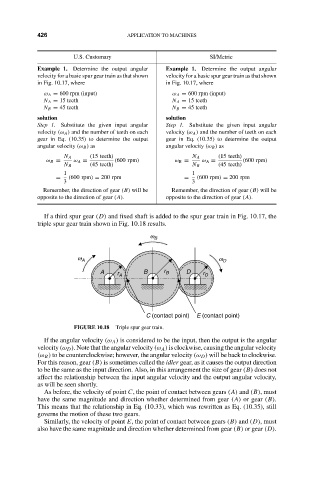
                    If a third spur gear (D) and fixed shaft is added to the spur gear train in Fig. 10.17, the
                  triple spur gear train shown in Fig. 10.18 results.
                                                 w B


                             w A                                   w D
                                   A    r A    B    r B    D   r D


                                                C (contact point)  E (contact point)
                            FIGURE 10.18  Triple spur gear train.

                    If the angular velocity (ω A ) is considered to be the input, then the output is the angular
                  velocity (ω D ). Note that the angular velocity (ω A ) is clockwise, causing the angular velocity
                  (ω B ) to be counterclockwise; however, the angular velocity (ω D ) will be back to clockwise.
                  For this reason, gear (B) is sometimes called the idler gear, as it causes the output direction
                  to be the same as the input direction. Also, in this arrangement the size of gear (B) does not
                  affect the relationship between the input angular velocity and the output angular velocity,
                  as will be seen shortly.
                    As before, the velocity of point C, the point of contact between gears (A) and (B), must
                  have the same magnitude and direction whether determined from gear (A) or gear (B).
                  This means that the relationship in Eq. (10.33), which was rewritten as Eq. (10.35), still
                  governs the motion of these two gears.
                    Similarly, the velocity of point E, the point of contact between gears (B) and (D), must
                  also have the same magnitude and direction whether determined from gear (B) or gear (D).

