


Page 138 - Materials Chemistry, Second Edition
P. 138
125
            2.4. The Amorphous State

            as AlPO 4 require the use of amines rather than quaternary salts. Both require the
            removal of the organic template via calcination in order to yield open-pore zeolitic
            structures.
              Synthesis may also be carried out at a lower pH using fluoride-containing media,

            wherein F ions are thought to act as structure directors via strong interactions with
            framework Si atoms. Consequently, the nucleation rate is decreased, which yields
            larger crystals relative to standard alkaline hydrothermal routes. [71]  The fluoride
            route under neutral/acidic pH conditions is also extremely useful to synthesize
            zeolite-like materials called zeotypes, which contain elements other than silicon
            and aluminum (e.g., titanosilicates, zirconosilicates, etc.). [72]  Under alkaline condi-
            tions, the precursors would be preferentially precipitated as hydroxide species rather
            than ordered arrays.


            2.4.2. Glasses

            From drinking vessels and windows to eyeglass lenses, materials comprising glass
            have long played an important role in our society. In fact, it is estimated that
            applications for glass date back to Egypt in ca. 3,500 B.C. Though we are most
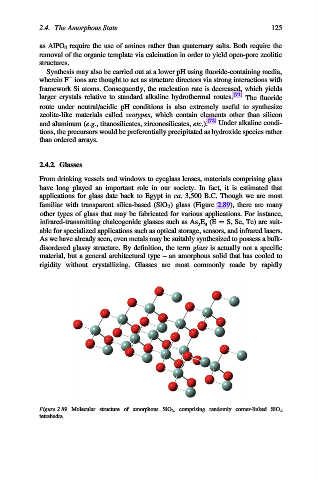
            familiar with transparent silica-based (SiO 2 ) glass (Figure 2.89), there are many
            other types of glass that may be fabricated for various applications. For instance,
            infrared-transmitting chalcogenide glasses such as As 2 E 3 (E ¼ S, Se, Te) are suit-
            able for specialized applications such as optical storage, sensors, and infrared lasers.
            As we have already seen, even metals may be suitably synthesized to possess a bulk-
            disordered glassy structure. By definition, the term glass is actually not a specific
            material, but a general architectural type – an amorphous solid that has cooled to
            rigidity without crystallizing. Glasses are most commonly made by rapidly


            Figure 2.89. Molecular structure of amorphous SiO 2 , comprising randomly corner-linked SiO 4
            tetrahedra.

