


Page 139 - Materials Chemistry, Second Edition
P. 139
126                                             2 Solid-State Chemistry


           quenching a melt; accordingly, the constituent atoms are not allowed to migrate into
           regular crystalline lattice positions. [73]
             It is noteworthy to point out why a material as disordered as glass is transparent.
           That is, one would think that the amorphous structure of glass should facilitate opacity,
           which is the extent to which visible radiation is blocked by the material it is passing
           through. There are two primary reasons for the transparency of glass – electronic
           and structural. First, as we will see shortly, glass may contain a variety of dopants that

           will afford particular colors (via electronic transitions) or physical properties (e.g.,
           enhanced hardness, thermal/electrical conductivity, reflectivity, etc.). However, these
           impurities are only present in sufficient quantity to cause only partial absorption of
           the electromagnetic spectrum, resulting in observable transparency – though less
           pronounced relative to undoped glass.
             Second, unlike metals, glasses are held together by covalent/ionic bonding, and
           do not contain free electrons in their structure. Accordingly, the incident wave-
           lengths are not perturbed into destructive waves and are free to transmit through the
           material. Additionally, the degree of disorder within glasses is of the same order of
           magnitude as the incident radiation, allowing the light to pass through relatively
           unattenuated. [74]  However, it should be noted that if glass contains imperfections,
           and/or inclusions of metals or larger particles with dimensions greater than the
           wavelength of indicent light, the material will become increasingly opaque due to
                                   [75]
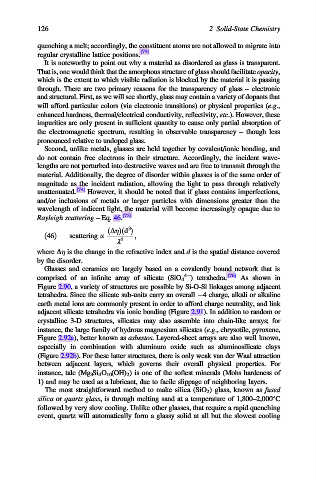
           Rayleigh scattering – Eq. 46.
                                    3
                               ðD Þðd Þ
             ð46Þ   scattering a  4   ;
                                 l
           where D  is the change in the refractive index and d is the spatial distance covered
           by the disorder.
             Glasses and ceramics are largely based on a covalently bound network that is
                                                    4
           comprised of an infinite array of silicate (SiO 4 ) tetrahedra. [76]  As shown in
           Figure 2.90, a variety of structures are possible by Si-O-Si linkages among adjacent
           tetrahedra. Since the silicate sub-units carry an overall  4 charge, alkali or alkaline
           earth metal ions are commonly present in order to afford charge neutrality, and link
           adjacent silicate tetrahedra via ionic bonding (Figure 2.91). In addition to random or
           crystalline 3-D structures, silicates may also assemble into chain-like arrays; for
           instance, the large family of hydrous magnesium silicates (e.g., chrysotile, pyroxene,
           Figure 2.92a), better known as asbestos. Layered-sheet arrays are also well known,
           especially in combination with aluminum oxide such as aluminosilicate clays
           (Figure 2.92b). For these latter structures, there is only weak van der Waal attraction
           between adjacent layers, which governs their overall physical properties. For
           instance, talc (Mg 3 Si 4 O 10 (OH) 2 ) is one of the softest minerals (Mohs hardeness of
           1) and may be used as a lubricant, due to facile slippage of neighboring layers.
             The most straightforward method to make silica (SiO 2 ) glass, known as fused
           silica or quartz glass, is through melting sand at a temperature of 1,800–2,000 C

           followed by very slow cooling. Unlike other glasses, that require a rapid quenching
           event, quartz will automatically form a glassy solid at all but the slowest cooling

