


Page 144 - MODELING OF ASPHALT CONCRETE
P. 144
122    Cha pte r  F i v e


               Theoretical Background
                    Historically, the pavement community utilized the elastic solutions for IDT testing that
                    Hondros (1959) derived using the plane stress assumption until Roque and Buttlar
                    (1992) introduced correction factors that accounted for the bulging effect of the specimen.
                    Later, Kim et al. (2000) introduced viscoelastic solutions for the IDT creep test using the
                    theory of linear viscoelasticity.
                       Unlike those of the uniaxial test specimens, the stress and strain distributions in IDT
                    specimens are biaxial. This biaxial state of stress and strain can cause errors in
                    determining the material properties obtained from the IDT test unless the derivation of
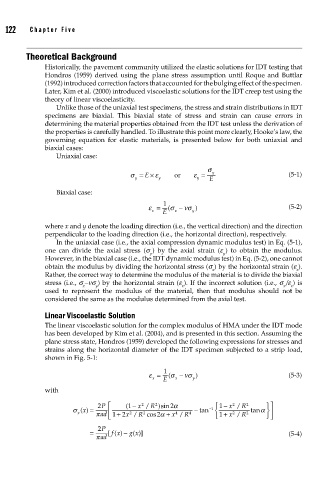
                    the properties is carefully handled. To illustrate this point more clearly, Hooke’s law, the
                    governing equation for elastic materials, is presented below for both uniaxial and
                    biaxial cases:
                       Uniaxial case:
                                                                  σ
                                            σ = E × ε y  or   ε =  E y                   (5-1)
                                                               y
                                              y
                       Biaxial case:
                                                      1
                                                 ε =  E  ( σ −  νσ )                     (5-2)
                                                         x
                                                              y
                                                  x
                    where x and y denote the loading direction (i.e., the vertical direction) and the direction
                    perpendicular to the loading direction (i.e., the horizontal direction), respectively.
                       In the uniaxial case (i.e., the axial compression dynamic modulus test) in Eq. (5-1),
                    one can divide the axial stress (s ) by the axial strain (e ) to obtain the modulus.
                                                  y                   y
                    However, in the biaxial case (i.e., the IDT dynamic modulus test) in Eq. (5-2), one cannot
                    obtain the modulus by dividing the horizontal stress (s ) by the horizontal strain (e ).
                                                                   x                       x
                    Rather, the correct way to determine the modulus of the material is to divide the biaxial
                    stress (i.e., s –ns ) by the horizontal strain (e ). If the incorrect solution (i.e., s /e ) is
                               x   y                       x                           x  x
                    used to represent the modulus of the material, then that modulus should not be
                    considered the same as the modulus determined from the axial test.
                    Linear Viscoelastic Solution
                    The linear viscoelastic solution for the complex modulus of HMA under the IDT mode
                    has been developed by Kim et al. (2004), and is presented in this section. Assuming the
                    plane stress state, Hondros (1959) developed the following expressions for stresses and
                    strains along the horizontal diameter of the IDT specimen subjected to a strip load,
                    shown in Fig. 5-1:
                                                  ε =  1  ( σ −  νσ )                    (5-3)
                                                  x
                                                      E
                                                              y
                                                         x
                    with
                                    P ⎡
                                                        α
                                               2
                                                   2
                                   2
                            σ x () =  πad 12 ( −1 2  x /  R )sin2 x /  R  4 4  − tan − 1  ⎧ ⎨ ⎩  1 − x  2 2  / R 2 2  tanα ⎫⎤
                                      ⎢
                                                                                   ⎬⎥
                                        +
                                                     α +
                                                         4
                             x
                                                2
                                                                          / R
                                                                     1 + x
                                           x /
                                               R cos2
                                      ⎣
                                                                                   ⎭⎦
                                 =  2P  [(  g x)]                                        (5-4)
                                       fx) −
                                             (
                                   π ad
                                     d

