


Page 145 - MODELING OF ASPHALT CONCRETE
P. 145
Complex Modulus fr om the Indir ect Tension Test    123


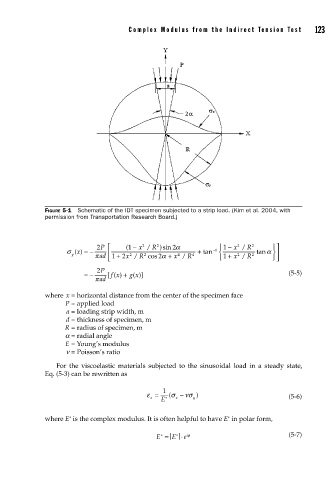
                    FIGURE 5-1  Schematic of the IDT specimen subjected to a strip load. (Kim et al. 2004, with
                    permission from Transportation Research Board.)


                                                2
                                   2 P ⎡   ( −1  x /  R )sin 2 α     ⎧ 1 −  x /  R  2  ⎫⎤
                                                                           2
                                                    2
                          σ x () =−   ⎢                        + tan − 1 ⎨      tanα ⎬⎥
                                            2
                            y     πad 1  + 2 x /  R cos 2 α +  x / R  4  ⎩ 1 +  x /  R  2  ⎭⎦
                                                2
                                                                           2
                                                          4
                                                            R
                                      ⎣
                                   2 P
                                       fx) +
                               =−     [(    g x)]                                       (5-5)
                                             (
                                  π πad
                    where x = horizontal distance from the center of the specimen face
                          P = applied load
                          a = loading strip width, m
                          d = thickness of specimen, m
                          R = radius of specimen, m
                          a = radial angle
                          E = Young’s modulus
                          n = Poisson’s ratio
                       For the viscoelastic materials subjected to the sinusoidal load in a steady state,
                    Eq. (5-3) can be rewritten as
                                                     1
                                                 ε =   ( σ − νσ )
                                                  x  E ∗  x   y                          (5-6)
                                                                        ∗
                           ∗
                    where E  is the complex modulus. It is often helpful to have E  in polar form,
                                                         ∗
                                                    E =  E ⋅  e iφ                       (5-7)
                                                     ∗

