


Page 146 - MODELING OF ASPHALT CONCRETE
P. 146
124    Cha pte r  F i v e

                            ∗
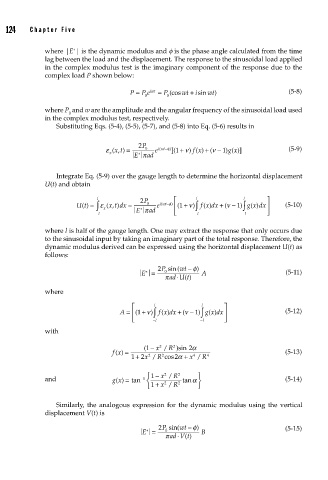
                    where |E | is the dynamic modulus and f is the phase angle calculated from the time
                    lag between the load and the displacement. The response to the sinusoidal load applied
                    in the complex modulus test is the imaginary component of the response due to the
                    complex load P shown below:
                                                             +
                                            P =  P e iwt  =  P (cos wt isin wt)          (5-8)
                                                0
                                                       0
                    where P  and w are the amplitude and the angular frequency of the sinusoidal load used
                           0
                    in the complex modulus test, respectively.
                       Substituting Eqs. (5-4), (5-5), (5-7), and (5-8) into Eq. (5-6) results in

                                               2 P
                                                                   ν
                                     ε xt) =     0  e iwt− φ) [( + ν f x) ( − 1 ) g x))]  (5-9)
                                                                 +
                                                    (
                                                                         (
                                                         1
                                                               (
                                       (
                                         ,
                                                             )
                                      x
                                             E ∗  πad
                       Integrate Eq. (5-9) over the gauge length to determine the horizontal displacement
                    U(t) and obtain
                                   l                     ⎡     l            l      ⎤
                                                                            ∫
                             Ut() = ε x ∫  ( x t dx =  2 P 0  e iwt−φ ) ⎢ ( + ν ) ∫  f x)dx + ( − 1 ) g ( )dx ⎥  (5-10)
                                                                       ν
                                                                               x
                                                     (
                                                          1
                                         )
                                                                 (
                                       ,
                                                                   )
                                               ∗
                                   l −        E π ad     ⎣ ⎢   l −           l −   ⎦ ⎥
                    where l is half of the gauge length. One may extract the response that only occurs due
                    to the sinusoidal input by taking an imaginary part of the total response. Therefore, the
                    dynamic modulus derived can be expressed using the horizontal displacement U(t) as
                    follows:
                                                    2 P sin( wt − )φ
                                               E =    0         A                       (5-11)
                                                 ∗
                                                      π ad U t ()
                                                         ⋅
                    where
                                             ⎡     l            l      ⎤
                                                 ν
                                                                  ( )
                                         A = ⎢ (1  + ) ∫  f xdx +( )  (ν − ) ∫  g xdx ⎥  (5-12)
                                                               1
                                             ⎣ ⎢   l −           l −   ⎦ ⎥
                    with
                                                ( −  x / R )sin  2α
                                                        2
                                                     2
                                                 1
                                       fx() =                                           (5-13)
                                              +
                                                              4
                                             12 x / R cos 2α +  x /  R 4
                                                 2
                                                     2
                                                      2
                                                 ⎧ 1  −  x / R  2  ⎫
                                                               ⎬
                    and                gx() = tan −1 ⎨     tanα                         (5-14)
                                                      2
                                                 ⎩ 1 +  x / R  2  ⎭
                       Similarly, the analogous expression for the dynamic modulus using the vertical
                    displacement V(t) is
                                                    2 P sin( wt − )φ                    (5-15)
                                                E =   0         B
                                                 ∗
                                                          ⋅
                                                      π ad V t ()

