


Page 147 - MODELING OF ASPHALT CONCRETE
P. 147
Complex Modulus fr om the Indir ect Tension Test    125


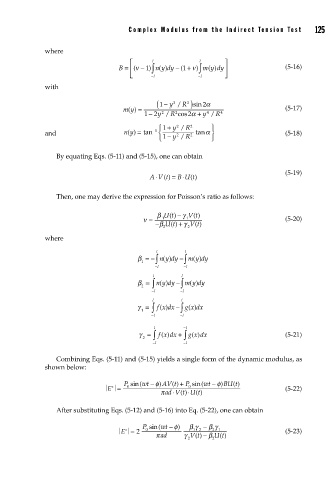
                    where
                                            ⎡     l             l      ⎤
                                                              ν
                                         B = ⎢ (ν − ) ∫  n y dy −( )  (1  + ) ∫ m y dy ⎥  (5-16)
                                                                  ( )
                                                 1
                                            ⎣ ⎢    l −          l −    ⎦ ⎥
                    with
                                                            2
                                                    (1 −  y / )sin 2α
                                                        2
                                                           R
                                          my() =                                        (5-17)
                                                 −
                                                                  4
                                                         2
                                                     2
                                                12  y / R cos 2α +  y /  R  4
                                                         2
                                                    ⎧ 1 +  y / R 2  ⎫
                    and                    ny () = tan −1 ⎨  −  2  2  tanα ⎬            (5-18)
                                                    ⎩ 1  y / R     ⎭
                       By equating Eqs. (5-11) and (5-15), one can obtain
                                                                                        (5-19)
                                                           ⋅
                                                  AV t =  B U t()
                                                   ⋅
                                                      ()
                       Then, one may derive the expression for Poisson’s ratio as follows:
                                                    β Ut()  −  γ V t()
                                                ν =  1      1                           (5-20)
                                                   − β Ut() +  γ V t()
                                                      2
                                                            2
                    where
                                                    l       l
                                                           ∫
                                                   ∫
                                                              ()
                                                     ()
                                              β =− n y dy  − m y dy
                                               1
                                                   −l      −l
                                                   l       l
                                               2 ∫        ∫
                                                     ()
                                              β = ny dy  − my()ddy
                                                  −l       l −
                                                   l       l
                                              γ  =  ∫  f x dx −()  ∫  g x dx
                                                             ()
                                               1
                                                   l −     l −
                                                   l       −l
                                                           ∫
                                                2 ∫
                                               γ =  f x dx  + g x dx                    (5-21)
                                                     (
                                                               )
                                                              (
                                                       )
                                                   −l      −l
                       Combining Eqs. (5-11) and (5-15) yields a single form of the dynamic modulus, as
                    shown below:
                                          P sin( wt − )φ AV t +  P sin( wt − )φ  BU t ( )
                                                        ( )
                                       ∗
                                      E =  0                 0                          (5-22)
                                                        ⋅
                                                     π ad V t ( )⋅Ut
                                                               ( )
                                                            )
                       After substituting Eqs. (5-12) and (5-16) into Eq. (5-22), one can obtain
                                                P sin( wt − )φ  βγ  − β γ
                                           ∗
                                          E = 2  0            1  2  2  1                (5-23)
                                                    π ad   γ  Vt − β U t ()
                                                               ()
                                                             2     2

