


Page 353 - Modern Control Systems
P. 353
Section 5.6  The Steady-State  Error of Feedback Control  Systems   327


                        /?(s)                                                        *•  tt.v)


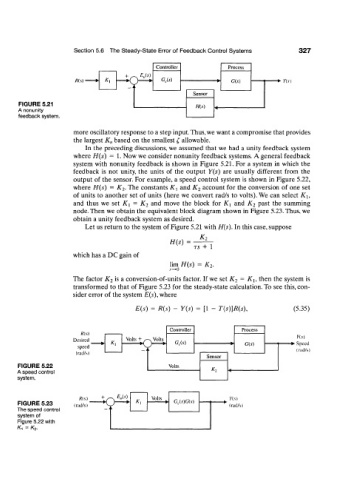
       FIGURE 5.21
       A nonunity
       feedback system.

                        more oscillatory response to a step input. Thus, we want a compromise that provides
                        the largest K v based on the smallest t, allowable.
                           In the preceding discussions, we assumed  that  we had a unity feedback  system
                        where H(s) =  1. Now we consider nonunity feedback  systems. A general  feedback
                        system with nonunity feedback  is shown  in Figure 5.21. For a system in which the
                        feedback  is not unity, the units  of the output  Y(s) are usually  different  from the
                        output  of the sensor. For example, a speed control  system is shown in Figure  5.22,
                        where H(s) =  K 2. The constants K\  and K 2 account for the conversion  of one set
                        of  units to another  set of units  (here  we convert  rad/s to volts). We can select  K\,
                        and  thus  we set K\ = K 2  and move  the block  for K\  and K 2  past  the summing
                       node. Then  we obtain the equivalent  block diagram  shown in Figure 5.23. Thus, we
                        obtain a unity feedback  system  as desired.
                           Let  us return to the system of Figure 5.21 with H(s). In this case, suppose


                                                            TS  +  1
                       which has a DC gain of
                                                     limtfOv)   K 7.
                                                     v—»0
                       The factor  K 2 is a conversion-of-units  factor. If we set K 2 = K h  then  the system is
                        transformed  to that  of Figure  5.23 for the steady-state  calculation. To see  this, con-
                       sider error of the system E(s), where
                                          E(s)  = R(s) -  Y(s) =  [1 -  T(s)]R(s),        (5.35)


                                                     Controller            Process
                                                                                           Y(s)
                        Desired        Volts +  / - .  Volts
                                                      G,(.v)                             - •  Speed
                         speed         — K J — •                            G(s)
                        (rad/s)                                                            (rad/s)
                                                                Sensor
       FIGURE 5.22                                  Volts
       A speed control                                           K,
       system.

                         R(s)                  Volts                   K(.v)
       FIGURE 5.23      (rad/s)   QZL                 G,(.v)G(.v)      (rad/s)
       The speed control
       system of
       Figure 5.22 with
       /C| = K 2.

