


Page 351 - Modern Control Systems
P. 351
Section 5.6  The Steady-State  Error of Feedback Control  Systems    325

                        Table 5.5  Summary of Steady-State Errors
                        Number of
                        Integrations                                Input
                        in GJs)G(s), Type      Step, r(t)  = A,     Ramp, At,        Parabola,
                        Number                 R(s)  =  A/s         A/s 2            A?/2,  A/s 3
                                                     A
                        0                      tss                  Infinite         Infinite
                                                 ~  1 +  K p
                                                                    A
                        1                                                            Infinite
                                                                    K,
                                                                                      A
                        2                                           0


                       The  steady-state  error  is infinite  for  one  integration. For  two integrations, N  = 2,
                       and we obtain

                                                          A
                                                Ccc                K                      (5.31)
                                                     KIU/IIP*       «

                                is designated  the  acceleration error constant. The acceleration  error con-
                       where K a
                       stant is
                                                           2
                                                  K a =  lim  s G c(s)G(s).
                                                       s—*0
                       When  the  number  of  integrations  equals  or  exceeds  three, then  the  steady-state
                       error  of the system is zero.
                           Control systems are often described in terms of their type number and the error
                       constants, K p, K v,  and  K a.  Definitions  for  the  error  constants  and  the  steady-state
                       error  for  the  three inputs  are  summarized  in Table  5.5. The  usefulness  of the  error
                       constants can be illustrated  by considering a simple example.

                       EXAMPLE   5.3  Mobile robot steering control
                       A mobile robot may be designed as an assisting device or servant for a severely dis-
                       abled person  [7]. The steering control system for  such a robot can be represented  by
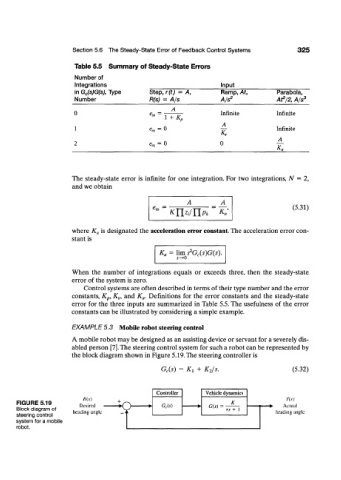
                       the block diagram shown in Figure 5.19. The steering controller is

                                                  G c(s)  =  K,  +  K 2/s.                (5.32)


                                                 Controller     Vehicle dynamics
                                                                                        Y{s)
      FIGURE 5.19        Desired      o           GAs)                 K           - •  Actual
      Block diagram of                                           G(s)   TS +  \      heading angle
      steering control   heading angle
      system for a mobile
      robot.

