


Page 354 - Modern Control Systems
P. 354
328              Chapter 5  The Performance  of Feedback  Control Systems

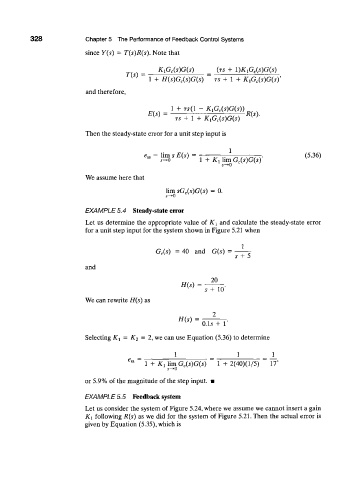
                           since Y(s)  =  T(s)R(s).  Note that

                                                 KiG c(s)G(s)      (TS  +  l)KiG c(s)G(s)
                                       r(s)  =
                                              1  +  H(s)G c(s)G(s)  TS  +  1 +  K!G c(s)G(sy
                           and  therefore,

                                                   _  1 +  rs(l  -  KjGMGjs))
                                              * {S)    TS  + 1 +  KtfMGis)    {S) '

                           Then the steady-state error for a unit step input is

                                                                       1
                                                =  lim s E(s)  =  ———^     ,  ,^,,  ,.        (5.36)
                                             e ss ss    w                                     v  J
                                                  , - o       1 +  K x  lim G e(s)G(s)
                                                                     s—»0
                           We assume here that

                                                    lim sG c(s)G(s)  =  0.
                                                    s—0

                           EXAMPLE 5.4    Steady-state error
                           Let  us determine  the  appropriate  value  of  K\  and  calculate  the steady-state  error
                           for a unit step input for the system shown in Figure  5.21 when


                                                G c(s)  = 40  and  G(s)  =  y ^

                           and


                           We can rewrite H(s) as

                                                                  2
                                                       H{s)  =
                                                               0.1s + 1

                                       =  Kj  = 2, we can use Equation  (5.36) to determine
                           Selecting K x
                                                      1                   1      =  1
                                        €ss
                                           ~  1 +  Id  lim G c(s)G(s)  "  1 +  2(40)(1/5)  "  17'
                                                    A—»0
                           or 5.9%  of the magnitude  of the step input.  •

                           EXAMPLE 5.5    Feedback system
                           Let us consider  the system  of Figure 5.24, where we assume we cannot insert a gain
                           Kx following  R(s)  as we did  for  the  system  of Figure  5.21. Then the  actual error  is
                           given by Equation  (5.35), which is

