


Page 352 - Modern Control Systems
P. 352
326              Chapter 5  The Performance of  Feedback  Control  Systems
                           Therefore,  the  steady-state  error  of  the  system  for  a step  input  when  K 2  =  0 and
                            G e(s)  = K x  is


                                                                                              (5.33)
                                                          Cc c
                                                               i  +  K;
                                    =       When K 2 is greater than zero, we have a type-1 system,
                           where K p   KK V
                                                               K xs  +  K 2
                                                       G e(s)  =

                           and the steady-state error is zero for a step input.
                               If the steering command  is a ramp input, the steady-state error is


                                                           e«  =                              (5.34)
                                                                K n
                           where

                                                      =  lim  sG c(s)G(s)  K 7K.
                                                   K v
                                                        s—»0
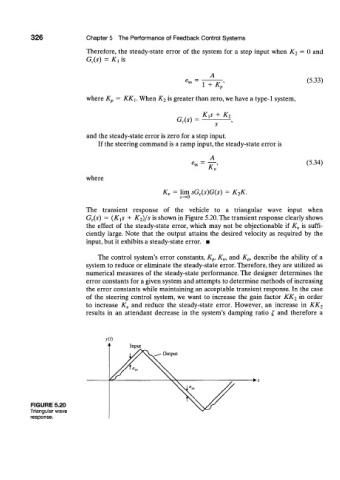
                           The  transient  response  of  the  vehicle  to  a  triangular  wave  input  when
                           G c(s)  =  (Kis  + K 2)/s  is shown in Figure 5.20. The transient response clearly shows
                           the  effect  of  the  steady-state  error, which  may not  be  objectionable  if  K v  is  suffi-
                           ciently  large. Note  that  the  output  attains  the  desired  velocity  as  required  by  the
                           input, but it exhibits a steady-state error.  •

                               The  control  system's  error  constants, K p, K m  and  K a,  describe  the  ability  of a
                           system to reduce or eliminate the steady-state error. Therefore, they are utilized  as
                           numerical  measures  of  the  steady-state  performance. The  designer  determines  the
                           error constants for a given system and attempts to determine methods  of increasing
                           the error constants  while maintaining  an  acceptable transient  response. In the case
                           of  the  steering  control  system,  we  want  to  increase  the  gain  factor  KK 2  in  order
                           to  increase  K v  and  reduce  the  steady-state  error.  However,  an  increase  in  KK 2
                           results  in  an  attendant  decrease  in  the  system's  damping  ratio  I  and  therefore  a


           FIGURE 5.20
           Triangular wave
           response.

