


Page 347 - Modern Control Systems
P. 347
Section 5.5  The s-Plane Root Location and the Transient  Response  321

                       poles  and  zeros  of  T(s)  that  determine  the  transient  response.  However,  for  a
                       closed-loop  system,  the  poles  of  T(s)  are  the  roots  of  the  characteristic  equation
                       A (s)  =  0  and  the  poles  of  2P;(.s)  A,-(.?). The  output  of  a  system  (with  gain  =  1)
                       without repeated  roots and a unit step input  can be formulated  as a partial  fraction
                       expansion as
                                                A/   Ai    N        B ks  + Q.
                                    Y(s)  =  - + 2      +  2    l                         (5.21)
                                               t=i s  + cr t  £=\ s  + 2a ks  + (a%  + w|)
                       where  the  A h  B k,  and  Q.  are  constants. The  roots  of  the  system  must  be  either
                       .y =  —ai or complex conjugate  pairs such as s  =  —a k ±  j<o k. Then the inverse trans-
                       form results in the  transient response  as the sum of terms
                                                M           N
                                     y(t)  = l  + 2>; e-rv  +  S V ^ i ^    +  **).       (5.22)
                                                /=1        k=\
                       where D k  is a constant  and depends on B k, C k, a k,  and o> k. The transient response is
                       composed  of  the  steady-state  output,  exponential  terms,  and  damped  sinusoidal
                       terms. For the response to be stable—that  is, bounded for a step input—the real part
                                     -
                       of  the roots,  —a/ and  -a k,  must be  in the left-hand  portion  of the .s-plane. The im-
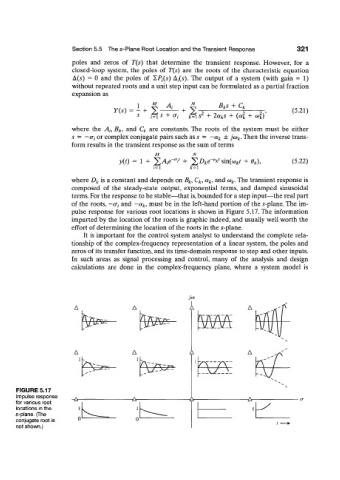
                       pulse  response  for  various root  locations  is shown  in Figure  5.17. The  information
                       imparted  by the location  of the roots is graphic indeed, and  usually  well worth  the
                       effort  of determining the location  of the roots in the 5-plane.
                           It  is important  for  the  control  system  analyst  to understand  the  complete  rela-
                       tionship  of  the  complex-frequency  representation  of  a linear  system, the poles  and
                       zeros of its transfer  function, and its time-domain response to step and other inputs.
                       In  such  areas  as  signal  processing  and  control,  many  of  the  analysis  and  design
                       calculations  are  done  in  the  complex-frequency  plane,  where  a  system  model  is


                        A                A                 A


                                         A                 A


      FIGURE 5.17
      Impulse response
      for various root   ^r-             -A-              -A-               -A-
      locations in the                     1
      s-plane. (The
      conjugate root is                    0
      not shown.)

