


Page 350 - Modern Control Systems
P. 350
324              Chapter 5  The Performance of  Feedback  Control Systems

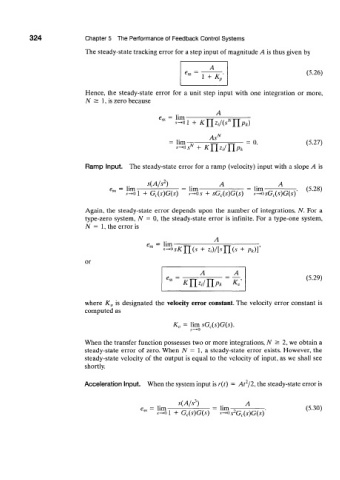
                           The steady-state  tracking error for  a step input  of magnitude  A  is thus given by

                                                                                              (5.26)


                           Hence,  the  steady-state  error  for  a  unit  step  input  with  one  integration  or  more,
                           N  a  1, is zero  because

                                                                        v
                                                 '"   isSi  +  *rW(.v' nft)

                                                                 Av' v
                                                                            =  0.             (5.27)
                                                    =
                                                       - 0 5 *  +  KUz f/UPk
                           Ramp  Input.  The  steady-state  error  for  a ramp  (velocity)  input  with  a slope  A  is

                                                  2
                                              s(A/s )
                                        lim               lim               =  lim-           (5.28)
                                       .v-ol  +  G c(s)G(s)  s-os  +  sG c{s)G(s)  .S-M)SG C(S)G(S)

                           Again,  the  steady-state  error  depends  upon  the  number  of  integrations,  N.  For  a
                           type-zero  system,  AT  =  0, the  steady-state  error  is infinite.  For  a  type-one  system,
                           N  =  1, the error  is

                                                                  A
                                              e«  =  lim
                                                   *-i>sKjl( S  +  z,)/[sll(s  +  Pk)Y

                           or
                                                              A
                                                    Cc c                                      (5.29)
                                                         KU^/UPk       K»

                           where  K v  is  designated  the  velocity  error  constant. The  velocity  error  constant  is
                           computed  as

                                                      K v=  \im  sG c(s)G(s).
                                                           s—*\)
                           When  the transfer  function  possesses  two or more  integrations, N  a  2, we obtain  a
                           steady-state  error  of  zero. When  JV  =  1,  a  steady-state  error  exists. However,  the
                           steady-state  velocity  of  the  output  is equal  to the  velocity  of  input,  as  we  shall  see
                           shortly.

                           Acceleration  Input.  When the system input  is r(t)  =  Ar/2,  the steady-state error is


                                                       s(A/f)              A
                                            e«  =  lim              lim   2                   (5.30)
                                                 v-ol  +  G e(s)G(s)  s->vs G c(s)G(s)

