


Page 470 - Book Hosokawa Nanoparticle Technology Handbook
P. 470
APPLICATIONS                              6 DESIGN OF NANOPARTICLES FOR ORAL DELIVERY OF PEPTIDE DRUGS


                                            Base materials
                                                        Nano-
                                                        particle      Drug
                                             Drug


                                     Drug-loaded              Drug-loading
                                     nano-carriers            • Retainable drug-stability
                                                              • High loading efficiency, high drug content


                                          Digestive enzymes
                                                     H +
                                            H +             H +

                                        H +               H +
                                                                   In the stomach
                                                                   • Protection against enzymatic degradation
                                                            H +    • Prevention of drug-leaching
                                 Digestive enzymes                 • Good redispersibility of nano-carriers
                                                H +  Digestive enzymes


                                                      Nano-carriers

                                                                     Mucus layer

                                                                     Absorptive enterocytes (EC)
                                                                     M cell (MC)
                             TJ
                                                                     Tight junction (TJ)
                                              MC               EC
                                                                       In the small intestine
                                                                       • Timing and mode of drug release
                                                                       • Redispersibility
                                                                       • Muco-adhesiveness / muco-penetrability
                            Lymphoid tissue (lymphocytes, macrophages)  • Translocation routes for drug and nano-carriers


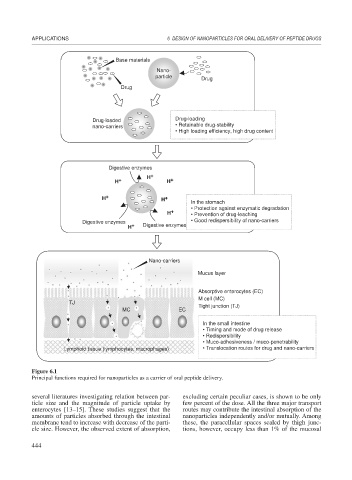
                  Figure 6.1
                  Principal functions required for nanoparticles as a carrier of oral peptide delivery.


                  several literatures investigating relation between par-  excluding certain peculiar cases, is shown to be only
                  ticle size and the magnitude of particle uptake by  few percent of the dose. All the three major transport
                  enterocytes [13–15]. These studies suggest that the  routes may contribute the intestinal absorption of the
                  amounts of particles absorbed through the intestinal  nanoparticles independently and/or mutually. Among
                  membrane tend to increase with decrease of the parti-  these, the paracellular spaces sealed by thigh junc-
                  cle size. However, the observed extent of absorption,  tions, however, occupy less than 1% of the mucosal

                  444

