


Page 295 - PRINCIPLES OF QUANTUM MECHANICS as Applied to Chemistry and Chemical Physics
P. 295
286 Appendix B
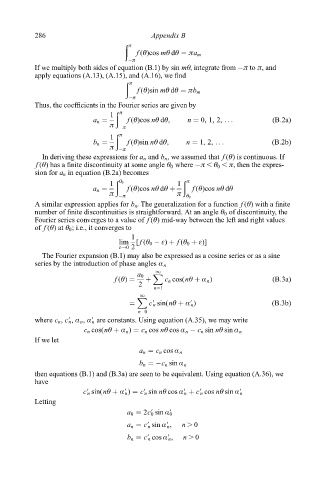
ð
f (è)cos mè dè ða m
ÿð
If we multiply both sides of equation (B.1) by sin mè, integrate from ÿð to ð, and
apply equations (A.13), (A.15), and (A.16), we ®nd
ð
f (è)sin mè dè ðb m
ÿð
Thus, the coef®cients in the Fourier series are given by
1
ð
a n f (è)cos nè dè, n 0, 1, 2, .. . (B:2a)
ð ÿð
1
ð
b n f (è)sin nè dè, n 1, 2, ... (B:2b)
ð ÿð
In deriving these expressions for a n and b n , we assumed that f (è) is continuous. If
f (è) has a ®nite discontinuity at some angle è 0 where ÿð , è 0 , ð, then the expres-
sion for a n in equation (B.2a) becomes
1
è 0 1
ð
a n f (è)cos nè dè f (è)cos nè dè
ð ÿð ð è 0
A similar expression applies for b n . The generalization for a function f (è) with a ®nite
number of ®nite discontinuities is straightforward. At an angle è 0 of discontinuity, the
Fourier series converges to a value of f (è) mid-way between the left and right values
of f (è)at è 0 ; i.e., it converges to
1
lim [f (è 0 ÿ å) f (è 0 å)]
å!0 2
The Fourier expansion (B.1) may also be expressed as a cosine series or as a sine
series by the introduction of phase angles á n
1
X
a 0
f (è) c n cos(nè á n ) (B:3a)
2
n1
1
X
c9 n sin(nè á9 n ) (B:3b)
n0
where c n , c9 n , á n , á9 n are constants. Using equation (A.35), we may write
c n cos(nè á n ) c n cos nè cos á n ÿ c n sin nè sin á n
If we let
a n c n cos á n
b n ÿc n sin á n
then equations (B.1) and (B.3a) are seen to be equivalent. Using equation (A.36), we
have
c9 n sin(nè á9 n ) c9 n sin nè cos á9 n c9 n cos nè sin á9 n
Letting
a 0 2c9 0 sin á9 0
a n c9 n sin á9 n , n . 0
b n c9 n cos á9 n , n . 0

