Page 296 - PRINCIPLES OF QUANTUM MECHANICS as Applied to Chemistry and Chemical Physics
P. 296
Fourier series and Fourier integral             287

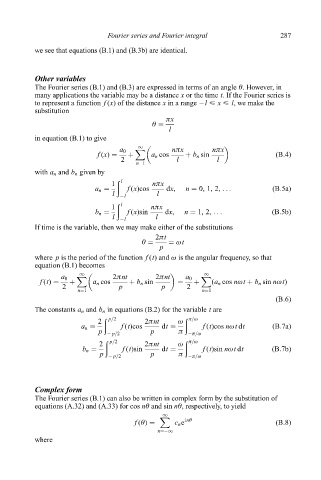
                        we see that equations (B.1) and (B.3b) are identical.


                        Other variables
                        The Fourier series (B.1) and (B.3) are expressed in terms of an angle è.However,in
                        many applications the variable may be a distance x or the time t. If the Fourier series is
                        to represent a function f (x) of the distance x in a range ÿl < x < l, we make the
                        substitution
                                                            ðx
                                                        è ˆ
                                                             l
                        in equation (B.1) to give
                                                    1
                                               a 0  X         nðx        nðx
                                         f (x) ˆ  ‡     a n cos   ‡ b n sin                (B:4)
                                                2              l           l
                                                    nˆ1
                        with a n and b n given by
                                             1  … l     nðx
                                        a n ˆ    f (x)cos   dx,   n ˆ 0, 1, 2, .. .       (B:5a)
                                             l  ÿl        l
                                              … l
                                             1          nðx
                                        b n ˆ    f (x)sin   dx,  n ˆ 1, 2, .. .           (B:5b)
                                             l  ÿl       l
                        If time is the variable, then we may make either of the substitutions
                                                         2ðt
                                                     è ˆ     ˆ ùt
                                                           p
                        where p is the period of the function f (t) and ù is the angular frequency, so that
                        equation (B.1) becomes

                                    1                                  1
                               a 0  X        2ðnt        2ðnt     a 0  X
                         f (t) ˆ  ‡     a n cos   ‡ b n sin     ˆ   ‡    (a n cos nùt ‡ b n sin nùt)
                               2               p           p      2
                                    nˆ1                               nˆ1
                                                                                           (B:6)
                        The constants a n and b n in equations (B.2) for the variable t are
                                           …  p=2                … ð=ù
                                         2            2ðnt      ù
                                     a n ˆ      f (t)cos   dt ˆ        f (t)cos nùt dt    (B:7a)
                                         p  ÿ p=2       p       ð  ÿð=ù
                                          2  …  p=2   2ðnt      ù  … ð=ù
                                     b n ˆ      f (t)sin   dt ˆ        f (t)sin nùt dt    (B:7b)
                                          p  ÿ p=2      p       ð  ÿð=ù


                        Complex form
                        The Fourier series (B.1) can also be written in complex form by the substitution of
                        equations (A.32) and (A.33) for cos nè and sin nè, respectively, to yield
                                                           1
                                                           X     inè
                                                    f (è) ˆ    c n e                       (B:8)
                                                          nˆÿ1
                        where
   291   292   293   294   295   296   297   298   299   300   301