Page 298 - PRINCIPLES OF QUANTUM MECHANICS as Applied to Chemistry and Chemical Physics
P. 298
Fourier series and Fourier integral             289
                                                  ð
                                                 …
                                                    e i(nÿm)è  dè ˆ 2ðä mn
                                                  ÿð
                        The ®nal result is
                                                 … ð             1
                                               1         2      X      2
                                                    jf (è)j dè ˆ    jc n j                (B:16)
                                               2ð  ÿð           nˆÿ1
                        which is one form of Parseval's theorem. Other forms of Parseval's theorem are
                        obtained using the various alternative Fourier expansions.
                          Parseval's theorem is also known as the completeness relation and may be used to
                        verify that the set of functions e inè  for ÿ1 < n < 1 are complete, as discussed in
                        Section 3.4. If some of the terms in the Fourier series are missing, so that the set of
                        basis functions in the expansion is incomplete, then the corresponding coef®cients on
                        the right-hand side of equation (B.16) will also be missing and the equality will not
                        hold.


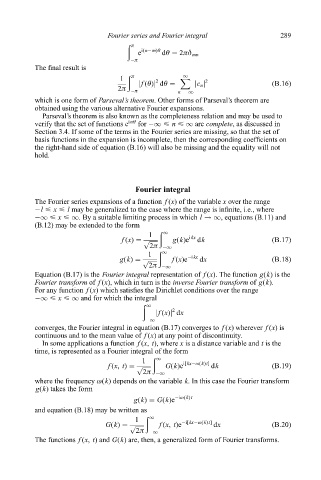
                                                    Fourier integral
                        The Fourier series expansions of a function f (x) of the variable x over the range
                        ÿl < x < l may be generalized to the case where the range is in®nite, i.e., where
                        ÿ1 < x < 1. By a suitable limiting process in which l !1, equations (B.11) and
                        (B.12) may be extended to the form
                                                          …
                                                       1   1       ikx
                                                f (x) ˆ p   g(k)e  dk               (B:17)
                                                        2ð ÿ1
                                                          …
                                                       1   1      ÿikx
                                               g(k) ˆ p   f (x)e  dx                (B:18)
                                                       2ð ÿ1
                        Equation (B.17) is the Fourier integral representation of f (x). The function g(k) is the
                        Fourier transform of f (x), which in turn is the inverse Fourier transform of g(k).
                        For any function f (x) which satis®es the Dirichlet conditions over the range
                        ÿ1 < x < 1 and for which the integral
                                                      …
                                                       1
                                                              2
                                                         jf (x)j dx
                                                       ÿ1
                        converges, the Fourier integral in equation (B.17) converges to f (x) wherever f (x)is
                        continuous and to the mean value of f (x) at any point of discontinuity.
                          In some applications a function f (x, t), where x is a distance variable and t is the
                        time, is represented as a Fourier integral of the form
                                                        …
                                                      1  1       i[kxÿù(k)t]
                                            f (x, t) ˆ p   G(k)e   dk               (B:19)
                                                      2ð ÿ1
                        where the frequency ù(k) depends on the variable k. In this case the Fourier transform
                        g(k) takes the form
                                                   g(k) ˆ G(k)e ÿiù(k)t
                        and equation (B.18) may be written as
                                                      …
                                                    1   1        ÿi[kxÿù(k)t]
                                           G(k) ˆ p   f (x, t)e     dx              (B:20)
                                                    2ð ÿ1
                        The functions f (x, t) and G(k) are, then, a generalized form of Fourier transforms.
   293   294   295   296   297   298   299   300   301   302   303