


Page 302 - PRINCIPLES OF QUANTUM MECHANICS as Applied to Chemistry and Chemical Physics
P. 302
Dirac delta function 293
as those in equations (C.5a±e). Thus, the expressions (C.5a±e) and similar ones
involving ä(x) are not to be taken as mathematical identities, but rather as operational
identities. One side can replace the other within an integral that includes the origin, for
ä(0), or the point x 0 for ä(x ÿ x 0 ).
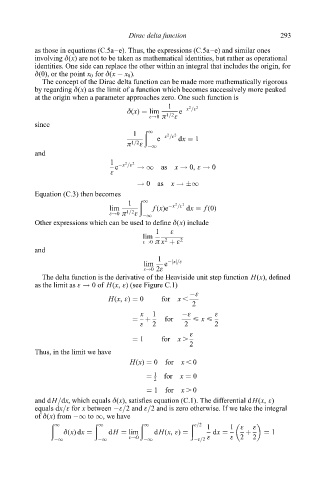
The concept of the Dirac delta function can be made more mathematically rigorous
by regarding ä(x) as the limit of a function which becomes successively more peaked
at the origin when a parameter approaches zero. One such function is
1 ÿx =å 2
2
ä(x) lim e
å!0 ð 1=2 å
since
1 1 ÿx =å 2
2
e dx 1
ð 1=2 å ÿ1
and
1 ÿx =å 2
2
å e !1 as x ! 0, å ! 0
! 0 as x ! 1
Equation (C.3) then becomes
1 1 ÿx =å 2
2
lim f (x)e dx f (0)
å!0 ð 1=2 å ÿ1
Other expressions which can be used to de®ne ä(x) include
1 å
lim
å!0 ð x å 2
2
and
1
lim e ÿjxj=å
å!0 2å
The delta function is the derivative of the Heaviside unit step function H(x), de®ned
as the limit as å ! 0of H(x, å) (see Figure C.1)
ÿå
H(x, å) 0 for x ,
2
x 1 ÿå å
for < x <
å 2 2 2
å
1 for x .
2
Thus, in the limit we have
H(x) 0 for x , 0
1
for x 0
2
1 for x . 0
and dH=dx, which equals ä(x), satis®es equation (C.1). The differential dH(x, å)
equals dx=å for x between ÿå=2 and å=2 and is zero otherwise. If we take the integral
of ä(x) from ÿ1 to 1,wehave
å=2
1 1 1 1 1 å å
ä(x)dx dH lim dH(x, å) dx 1
å!0 å å 2 2
ÿ1 ÿ1 ÿ1 ÿå=2

