


Page 301 - PRINCIPLES OF QUANTUM MECHANICS as Applied to Chemistry and Chemical Physics
P. 301
Appendix C
Dirac delta function
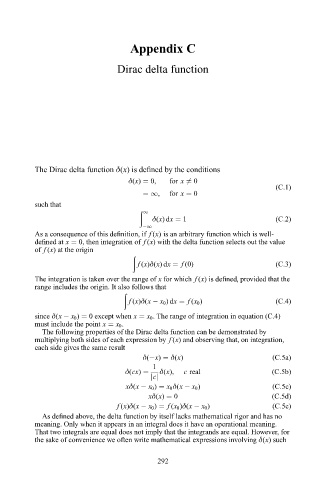
The Dirac delta function ä(x) is de®ned by the conditions
ä(x) 0, for x 6 0
(C:1)
1, for x 0
such that
1
ä(x)dx 1 (C:2)
ÿ1
As a consequence of this de®nition, if f (x) is an arbitrary function which is well-
de®ned at x 0, then integration of f (x) with the delta function selects out the value
of f (x) at the origin
f (x)ä(x)dx f (0) (C:3)
The integration is taken over the range of x for which f (x) is de®ned, provided that the
range includes the origin. It also follows that
f (x)ä(x ÿ x 0 )dx f (x 0 ) (C:4)
since ä(x ÿ x 0 ) 0 except when x x 0 . The range of integration in equation (C.4)
must include the point x x 0 .
The following properties of the Dirac delta function can be demonstrated by
multiplying both sides of each expression by f (x) and observing that, on integration,
each side gives the same result
ä(ÿx) ä(x) (C:5a)
1
ä(cx) ä(x), c real (C:5b)
jcj
xä(x ÿ x 0 ) x 0 ä(x ÿ x 0 ) (C:5c)
xä(x) 0 (C:5d)
f (x)ä(x ÿ x 0 ) f (x 0 )ä(x ÿ x 0 ) (C:5e)
As de®ned above, the delta function by itself lacks mathematical rigor and has no
meaning. Only when it appears in an integral does it have an operational meaning.
That two integrals are equal does not imply that the integrands are equal. However, for
the sake of convenience we often write mathematical expressions involving ä(x) such
292

