


Page 300 - PRINCIPLES OF QUANTUM MECHANICS as Applied to Chemistry and Chemical Physics
P. 300
Fourier series and Fourier integral 291
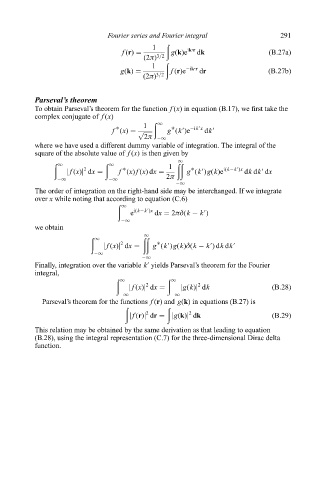
1 ik r
.
f (r) g(k)e dk (B:27a)
(2ð) 3=2
1 ÿik r
.
g(k) f (r)e dr (B:27b)
(2ð) 3=2
Parseval's theorem
To obtain Parseval's theorem for the function f (x) in equation (B.17), we ®rst take the
complex conjugate of f (x)
1
1
ÿik9x
f (x) p g (k9)e dk9
2ð ÿ1
where we have used a different dummy variable of integration. The integral of the
square of the absolute value of f (x) is then given by
1
1 1 1
2 i(kÿk9)x
jf (x)j dx f (x)f (x)dx g (k9)g(k)e dk dk9 dx
2ð
ÿ1 ÿ1
ÿ1
The order of integration on the right-hand side may be interchanged. If we integrate
over x while noting that according to equation (C.6)
1
e i(kÿk9)x dx 2ðä(k ÿ k9)
ÿ1
we obtain
1
1
2
jf (x)j dx g (k9)g(k)ä(k ÿ k9)dk dk9
ÿ1
ÿ1
Finally, integration over the variable k9 yields Parseval's theorem for the Fourier
integral,
1 1
2 2
jf (x)j dx jg(k)j dk (B:28)
ÿ1 ÿ1
Parseval's theorem for the functions f (r) and g(k) in equations (B.27) is
2
2
jf (r)j dr jg(k)j dk (B:29)
This relation may be obtained by the same derivation as that leading to equation
(B.28), using the integral representation (C.7) for the three-dimensional Dirac delta
function.

