


Page 314 - PRINCIPLES OF QUANTUM MECHANICS as Applied to Chemistry and Chemical Physics
P. 314
Legendre and associated Legendre polynomials 305
m
d g(ì, s)
2 m=2
(m)
g (ì, s) (1 ÿ ì )
dì m
Since
m
d g(ì, s) m 2 ÿ(m )
:
1
: :
3 5 (2m ÿ 1)s (1 ÿ 2ìs s ) 2
dì m
(2m)! 1
2 ÿ(m )
m
s (1 ÿ 2ìs s ) 2
m
2 m!
we have
1 2 m=2 m
X m l (2m)!(1 ÿ ì ) s
(m)
g (ì, s) P (ì)s m 1 (E:11)
l
2 m
lm 2 m!(1 ÿ 2ìs s ) 2
m
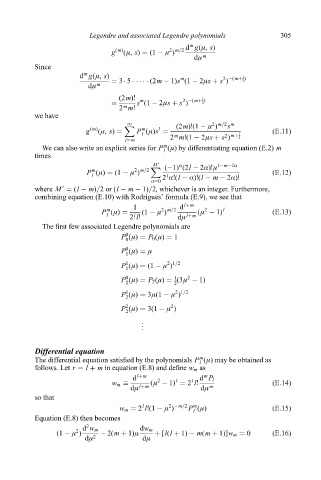
We can also write an explicit series for P (ì) by differentiating equation (E.2) m
l
times
M9 á lÿmÿ2á
X (ÿ1) (2l ÿ 2á)!ì
m
2 m=2
P (ì) (1 ÿ ì ) (E:12)
l 2 á!(l ÿ á)!(l ÿ m ÿ 2á)!
l
á0
where M9 (l ÿ m)=2or(l ÿ m ÿ 1)=2, whichever is an integer. Furthermore,
combining equation (E.10) with Rodrigues' formula (E.9), we see that
1 d lm
m 2 m=2 2 l
P (ì) (1 ÿ ì ) (ì ÿ 1) (E:13)
l l lm
2 l! dì
The ®rst few associated Legendre polynomials are
0
P (ì) P 0 (ì) 1
0
0
P (ì) ì
1
1
2 1=2
P (ì) (1 ÿ ì )
1
0
2
1
P (ì) P 2 (ì) (3ì ÿ 1)
2 2
1
2 1=2
P (ì) 3ì(1 ÿ ì )
2
2
2
P (ì) 3(1 ÿ ì )
2
.
.
.
Differential equation
m
The differential equation satis®ed by the polynomials P (ì) may be obtained as
l
follows. Let r l m in equation (E.8) and de®ne w m as
m
d lm 2 l l d P l
w m (ì ÿ 1) 2 l! (E:14)
dì lm dì m
so that
m
l
2 ÿm=2
w m 2 l!(1 ÿ ì ) P (ì) (E:15)
l
Equation (E.8) then becomes
2
2
(1 ÿ ì ) d w m ÿ 2(m 1)ì dw m [l(l 1) ÿ m(m 1)]w m 0 (E:16)
dì 2 dì

