


Page 319 - PRINCIPLES OF QUANTUM MECHANICS as Applied to Chemistry and Chemical Physics
P. 319
Appendix F
Laguerre and associated Laguerre polynomials
Laguerre polynomials
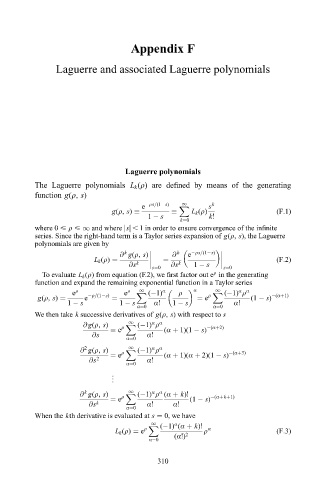
The Laguerre polynomials L k (r) are de®ned by means of the generating
function g(r, s)
1
e ÿrs=(1ÿs) X s k
g(r, s) L k (r) (F:1)
1 ÿ s k!
k0
where 0 < r < 1 and where jsj , 1 in order to ensure convergence of the in®nite
series. Since the right-hand term is a Taylor series expansion of g(r, s), the Laguerre
polynomials are given by
k k
@ g(r, s) @ e ÿrs=(1ÿs)
L k (r) (F:2)
@s k @s k 1 ÿ s
s0 s0
r
To evaluate L k (r) from equation (F.2), we ®rst factor out e in the generating
function and expand the remaining exponential function in a Taylor series
á á
1
1
e r ÿr=(1ÿs) e r X (ÿ1) á r á r X (ÿ1) r ÿ(á1)
g(r, s) e e (1 ÿ s)
1 ÿ s 1 ÿ s á! 1 ÿ s á!
á0 á0
We then take k successive derivatives of g(r, s) with respect to s
á á
1
@ g(r, s) r X (ÿ1) r ÿ(á2)
e (á 1)(1 ÿ s)
@s á!
á0
2
á á
1
@ g(r, s) r X (ÿ1) r ÿ(á3)
e (á 1)(á 2)(1 ÿ s)
@s 2 á!
á0
. . .
á á
k
1
@ g(r, s) X (ÿ1) r (á k)!
e r (1 ÿ s) ÿ(ák1)
@s k á! á!
á0
When the kth derivative is evaluated at s 0, we have
á
1 (ÿ1) (á k)!
X
L k (r) e r r á (F:3)
(á!) 2
á0
310

