


Page 322 - PRINCIPLES OF QUANTUM MECHANICS as Applied to Chemistry and Chemical Physics
P. 322
Laguerre and associated Laguerre polynomials 313
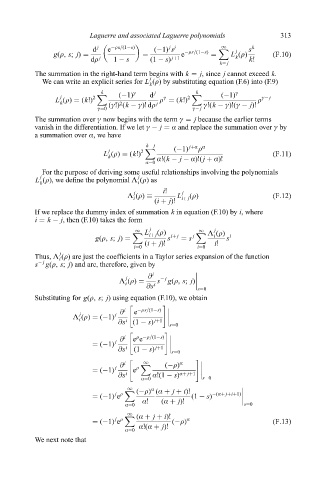
ÿrs=(1ÿs) j j k
j
1
d e (ÿ1) s ÿrs=(1ÿs) X j s
g(r, s; j) e L (r) (F:10)
k
dr j 1 ÿ s (1 ÿ s) j1 k!
k j
The summation in the right-hand term begins with k j, since j cannot exceed k.
j
We can write an explicit series for L (r) by substituting equation (F.6) into (F.9)
k
k ã j k ã
X (ÿ1) d X (ÿ1)
j 2 ã 2 ãÿ j
L (r) (k!) r (k!) r
k (ã!) (k ÿ ã)! dr j ã!(k ÿ ã)!(ã ÿ j)!
2
ã0 ã j
The summation over ã now begins with the term ã j because the earlier terms
vanish in the differentiation. If we let ã ÿ j á and replace the summation over ã by
a summation over á,we have
kÿ j já á
X (ÿ1) r
j 2
L (r) (k!) (F:11)
k á!(k ÿ j ÿ á)!(j á)!
á0
For the purpose of deriving some useful relationships involving the polynomials
j
j
L (r), we de®ne the polynomial Ë (r)as
k i
i!
j j
Ë (r) L i j (r) (F:12)
i
(i j)!
If we replace the dummy index of summation k in equation (F.10) by i, where
i k ÿ j, then (F.10) takes the form
j j
1
1
X L (r) X
i j i j j Ë (r) i
i
g(r, s; j) s s s
(i j)! i!
i0 i0
j
Thus, Ë (r) are just the coef®cients in a Taylor series expansion of the function
i
s ÿ j g(r, s; j) and are, therefore, given by
@ i
j ÿ j
Ë (r) s g(r, s; j)
i
@s i
s0
Substituting for g(r, s; j) using equation (F.10), we obtain
" #
@ i e ÿrs=(1ÿs)
j j
Ë (r) (ÿ1)
i i
@s (1 ÿ s) j1
s0
" #
@ i e e
r ÿr=(1ÿs)
(ÿ1) j
@s i (1 ÿ s) j1
s0
" #
1
@ i X (ÿr) á
(ÿ1) j e r
@s i á!(1 ÿ s) á j1
á0 s0
á
1 (ÿr) (á j i)!
X
j r
(ÿ1) e (1 ÿ s) ÿ(á ji1)
á! (á j)!
á0 s0
1
X (á j i)!
j r
(ÿ1) e (ÿr) á (F:13)
á!(á j)!
á0
We next note that

