Page 325 - PRINCIPLES OF QUANTUM MECHANICS as Applied to Chemistry and Chemical Physics
P. 325
316                              Appendix F
                                             1    á  …  1               1
                                            X   (st)    j ÿr  j  2     X     á!     á
                                                      r e [L (r)] dr ˆ            (st)
                                                             á
                                               (á!) 2                      (á ÿ j)!
                                            ሠj     0                  ሠj
                                                    á
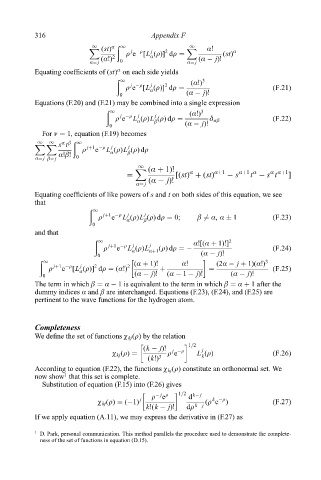
                             Equating coef®cients of (st) on each side yields
                                                    …                       3
                                                     1                   (á!)
                                                        j ÿr  j  2
                                                      r e [L (r)] dr ˆ                          (F:21)
                                                             á
                                                     0                 (á ÿ j)!
                             Equations (F.20) and (F.21) may be combined into a single expression
                                                 …                         3
                                                  1                     (á!)
                                                          j
                                                               j
                                                     j ÿr
                                                   r e  L (r)L (r)dr ˆ        ä áâ              (F:22)
                                                              â
                                                          á
                                                  0                    (á ÿ j)!
                               For í ˆ 1, equation (F.19) becomes
                             X X á â    … 1            j
                              1
                                 1
                                    s t
                                                  j
                                          r j‡1 ÿr L (r)L (r)dr
                                              e
                                    á!â!          á    â
                             ሠj ∠j   0
                                                          1
                                                         X   (á ‡ 1)!   á      á‡1    á‡1 á    á á‡1
                                                       ˆ            [(st) ‡ (st)   ÿ s   t ÿ s t    ]
                                                             (á ÿ j)!
                                                         ሠj
                             Equating coef®cients of like powers of s and t on both sides of this equation, we see
                             that
                                            …
                                             1
                                                       j
                                                            j
                                               r j‡1 ÿr  L (r)L (r)dr ˆ 0;  â 6ˆ á, á   1       (F:23)
                                                  e
                                                           â
                                                       á
                                             0
                             and that
                                              …                                    2
                                               1                         á![(á ‡ 1)!]
                                                             j
                                                r j‡1 ÿr L (r)L á‡1 (r)dr ˆÿ                    (F:24)
                                                        j
                                                    e
                                                        á
                                               0                           (á ÿ j)!
                              …
                               1                         (á ‡ 1)!     á!        (2á ÿ j ‡ 1)(á!) 3
                                 r j‡1 ÿr  á j  2      2        ‡             ˆ                 (F:25)
                                     e [L (r)] dr ˆ (á!)
                               0                         (á ÿ j)!  (á ÿ 1 ÿ j)!     (á ÿ j)!
                             The term in which ⠈ á ÿ 1 is equivalent to the term in which ⠈ á ‡ 1 after the
                             dummy indices á and â are interchanged. Equations (F.23), (F.24), and (F.25) are
                             pertinent to the wave functions for the hydrogen atom.
                             Completeness
                             We de®ne the set of functions ÷ kj (r) by the relation
                                                                         1=2
                                                           (k ÿ j)!  j ÿr   j
                                                   ÷ kj (r) ˆ     r e     L (r)                 (F:26)
                                                                            k
                                                             (k!) 3
                             According to equation (F.22), the functions ÷ kj (r) constitute an orthonormal set. We
                                     1
                             now show that this set is complete.
                               Substitution of equation (F.15) into (F.26) gives
                                                              r e     1=2  d kÿ j
                                                               ÿ j r
                                                                               k ÿr
                                               ÷ kj (r) ˆ (ÿ1) j             (r e )             (F:27)
                                                            k!(k ÿ j)!  dr kÿ j
                             If we apply equation (A.11), we may express the derivative in (F.27) as
                             1  D. Park, personal communication. This method parallels the procedure used to demonstrate the complete-
                              ness of the set of functions in equation (D.15).
   320   321   322   323   324   325   326   327   328   329   330