Page 323 - PRINCIPLES OF QUANTUM MECHANICS as Applied to Chemistry and Chemical Physics
P. 323
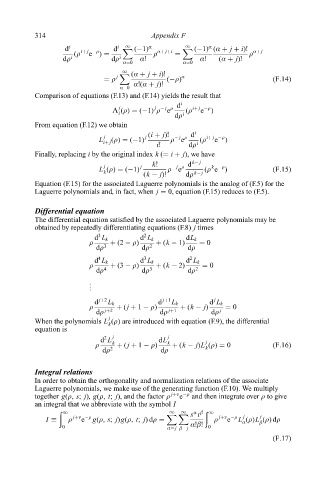
314                              Appendix F
                                                                              á
                                                      1
                                                                       1
                                     d i  i‡ j ÿr  d  i X  (ÿ1) á  á‡ j‡i  X  (ÿ1) (á ‡ j ‡ i)!  ᇠj
                                        (r  e ) ˆ             r     ˆ                    r
                                     dr i         dr i    á!               á!   (á ‡ j)!
                                                      áˆ0             áˆ0
                                                     1
                                                     X  (á ‡ j ‡ i)!
                                                ˆ r j             (ÿr) á                        (F:14)
                                                         á!(á ‡ j)!
                                                     áˆ0
                             Comparison of equations (F.13) and (F.14) yields the result that
                                                     j
                                                              j ÿ j r
                                                   Ë (r) ˆ (ÿ1) r e  d i  (r i‡ j ÿr
                                                                           e )
                                                    i
                                                                    dr i
                             From equation (F.12) we obtain
                                                             (i ‡ j)!    d i
                                                j           j       ÿ j r    i‡ j ÿr
                                               L  (r) ˆ (ÿ1)       r e     (r  e )
                                                i‡ j                      i
                                                               i!       dr
                             Finally, replacing i by the original index k (ˆ i ‡ j), we have
                                                              k!   ÿ j r  d kÿ j  k ÿr
                                                          j
                                                j
                                               L (r) ˆ (ÿ1)       r e       (r e )              (F:15)
                                                k          (k ÿ j)!    dr kÿ j
                             Equation (F.15) for the associated Laguerre polynomials is the analog of (F.5) for the
                             Laguerre polynomials and, in fact, when j ˆ 0, equation (F.15) reduces to (F.5).
                             Differential equation
                             The differential equation satis®ed by the associated Laguerre polynomials may be
                             obtained by repeatedly differentiating equations (F.8) j times
                                               3           2
                                            r  d L k  ‡ (2 ÿ r)  d L k  ‡ (k ÿ 1)  dL k  ˆ 0
                                              dr 3         dr 2         dr
                                               4           3            2
                                            r  d L k  ‡ (3 ÿ r)  d L k  ‡ (k ÿ 2)  d L k  ˆ 0
                                              dr 4         dr 3         dr 2
                                            .
                                            . .
                                                                               j
                                              d j‡2  L k        d j‡1  L k    d L k
                                            r       ‡ (j ‡ 1 ÿ r)     ‡ (k ÿ j)   ˆ 0
                                              dr  j‡2           dr j‡1        dr  j
                                                  j
                             When the polynomials L (r) are introduced with equation (F.9), the differential
                                                  k
                             equation is
                                                2
                                               d L  j           dL j         j
                                              r    k  ‡ (j ‡ 1 ÿ r)  k  ‡ (k ÿ j)L (r) ˆ 0      (F:16)
                                                dr 2            dr           k
                             Integral relations
                             In order to obtain the orthogonality and normalization relations of the associate
                             Laguerre polynomials, we make use of the generating function (F.10). We multiply
                             together g(r, s; j), g(r, t; j), and the factor r  j‡í ÿr  and then integrate over r to give
                                                                     e
                             an integral that we abbreviate with the symbol I
                                    …                                       …
                                                                      1
                                                                   1
                                                                         s t
                                     1                            X X á â     1             j
                                                                                       j
                                          e
                                                                                   e
                                I     r j‡í ÿr  g(r, s; j)g(r, t; j)dr ˆ       r j‡í ÿr L (r)L (r)dr
                                                                                            â
                                                                                       á
                                     0                            ሠj ∠j  á!â!  0
                                                                                                (F:17)
   318   319   320   321   322   323   324   325   326   327   328