


Page 324 - PRINCIPLES OF QUANTUM MECHANICS as Applied to Chemistry and Chemical Physics
P. 324
Laguerre and associated Laguerre polynomials 315
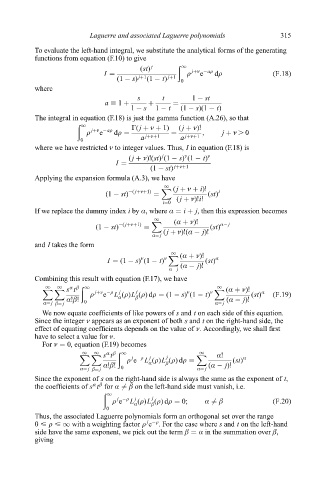
To evaluate the left-hand integral, we substitute the analytical forms of the generating
functions from equation (F.10) to give
(st) j
1 jí ÿar
I r e dr (F:18)
(1 ÿ s) j1 (1 ÿ t) j1 0
where
s t 1 ÿ st
a 1
1 ÿ s 1 ÿ t (1 ÿ s)(1 ÿ t)
The integral in equation (F.18) is just the gamma function (A.26), so that
1 Ã(j í 1) (j í)!
r jí ÿar dr , j í . 0
e
0 a jí1 a jí1
where we have restricted í to integer values. Thus, I in equation (F.18) is
í
j
(j í)!(st) (1 ÿ s) (1 ÿ t) í
I
(1 ÿ st) jí1
Applying the expansion formula (A.3), we have
1
X (j í i)!
(1 ÿ st) ÿ( jí1) (st) i
(j í)!i!
i0
If we replace the dummy index i by á, where á i j, then this expression becomes
1
X (á í)!
(1 ÿ st) ÿ( jí1) (st) áÿ j
(j í)!(á ÿ j)!
á j
and I takes the form
1 (á í)!
X
í
I (1 ÿ s) (1 ÿ t) í (st) á
(á ÿ j)!
á j
Combining this result with equation (F.17), we have
X X á â
1 X (á í)!
1
1
1
s t
í
j
j
r jí ÿr L (r)L (r)dr (1 ÿ s) (1 ÿ t) í (st) á (F:19)
e
á!â! á â (á ÿ j)!
á j â j 0 á j
We now equate coef®cients of like powers of s and t on each side of this equation.
Since the integer í appears as an exponent of both s and t on the right-hand side, the
effect of equating coef®cients depends on the value of í. Accordingly, we shall ®rst
have to select a value for í.
For í 0, equation (F.19) becomes
X X á â
1 j X á!
1
1
1
s t
j ÿr
j
r e L (r)L (r)dr (st) á
á
á!â! â (á ÿ j)!
á j â j 0 á j
Since the exponent of s on the right-hand side is always the same as the exponent of t,
á â
the coef®cients of s t for á 6 â on the left-hand side must vanish, i.e.
1
j ÿr
j
j
r e L (r)L (r)dr 0; á 6 â (F:20)
â
á
0
Thus, the associated Laguerre polynomials form an orthogonal set over the range
j ÿr
0 < r < 1 with a weighting factor r e . For the case where s and t on the left-hand
side have the same exponent, we pick out the term â á in the summation over â,
giving

