Page 326 - PRINCIPLES OF QUANTUM MECHANICS as Applied to Chemistry and Chemical Physics
P. 326
Laguerre and associated Laguerre polynomials         317
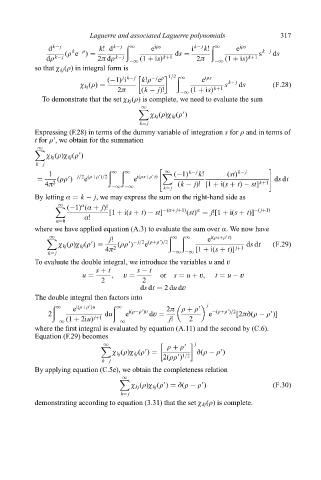
                           d kÿ j  k ÿr   k! d kÿ j  …  1  e irs   i kÿ j k!  …  1  e irs  kÿ j
                                (r e ) ˆ                       ds ˆ                   s   ds
                           dr kÿ j       2ð dr kÿ j  (1 ‡ is) k‡1    2ð      (1 ‡ is) k‡1
                                                  ÿ1                      ÿ1
                        so that ÷ kj (r) in integral form is
                                                        ÿ j r 1=2…
                                                j kÿ j
                                            (ÿ1) i    k!r e     1     e irs   kÿ j
                                    ÷ kj (r) ˆ                               s   ds       (F:28)
                                               2ð    (k ÿ j)!      (1 ‡ is) k‡1
                                                                ÿ1
                          To demonstrate that the set ÷ kj (r) is complete, we need to evaluate the sum
                                                     1
                                                     X
                                                        ÷ kj (r)÷ kj (r9)
                                                     kˆ j
                        Expressing (F.28) in terms of the dummy variable of integration s for r and in terms of
                        t for r9, we obtain for the summation
                        1
                        X
                           ÷ kj (r)÷ kj (r9)
                        kˆ j
                                                          "                              #
                                            …   …           1      kÿ j         kÿ j
                           1      ÿ j=2 (r‡r9)=2  1  1  i(rs‡r9t)  X  (ÿ1)  k!  (st)
                        ˆ     (rr9)  e             e                                       ds dt
                          4ð 2                                  (k ÿ j)! [1 ‡ i(s ‡ t) ÿ st] k‡1
                                             ÿ1 ÿ1
                                                            kˆ j
                        By letting á ˆ k ÿ j, we may express the sum on the right-hand side as
                              1      á
                             X   (ÿ1) (á ‡ j)!             ÿ(ᇠj‡1)  á              ÿ( j‡1)
                                            [1 ‡ i(s ‡ t) ÿ st]   (st) ˆ j![1 ‡ i(s ‡ t)]
                                     á!
                             áˆ0
                        where we have applied equation (A.3) to evaluate the sum over á. We now have
                                                             …   …
                            1                                 1   1      i(rs‡r9t)
                           X                j!     ÿ j=2 (r‡r9)=2       e
                              ÷ kj (r)÷ kj (r9) ˆ  (rr9)  e                        ds dt  (F:29)
                                           4ð 2                      [1 ‡ i(s ‡ t)] j‡1
                           kˆ j                               ÿ1 ÿ1
                        To evaluate the double integral, we introduce the variables u and v
                                         s ‡ t      s ÿ t
                                     u ˆ     ,  v ˆ        or  s ˆ u ‡ v,  t ˆ u ÿ v
                                          2           2
                                                     ds dt ˆ 2du dv
                        The double integral then factors into

                            …      i(r‡r9)u  …                          j
                             1    e           1             2ð r ‡ r9
                           2               du    e i(rÿr9)v  dv ˆ       e ÿ(r‡r9)=2 [2ðä(r ÿ r9)]
                                (1 ‡ 2iu) j‡1                j!    2
                             ÿ1               ÿ1
                        where the ®rst integral is evaluated by equation (A.11) and the second by (C.6).
                        Equation (F.29) becomes
                                                                     j
                                           1
                                          X                  r ‡ r9
                                             ÷ kj (r)÷ kj (r9) ˆ     ä(r ÿ r9)
                                                           2(rr9) 1=2
                                          kˆ j
                        By applying equation (C.5e), we obtain the completeness relation
                                                1
                                               X
                                                   ÷ kj (r)÷ kj (r9) ˆ ä(r ÿ r9)          (F:30)
                                                kˆ j
                        demonstrating according to equation (3.31) that the set ÷ kj (r) is complete.
   321   322   323   324   325   326   327   328   329   330   331