


Page 317 - PRINCIPLES OF QUANTUM MECHANICS as Applied to Chemistry and Chemical Physics
P. 317
308 Appendix E
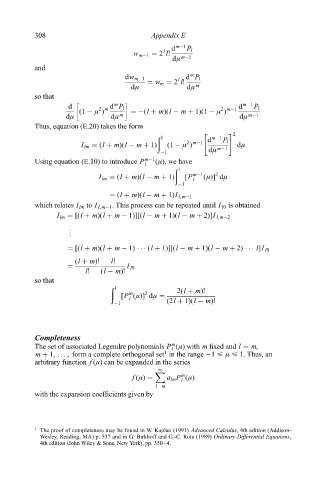
d mÿ1 P l
l
w mÿ1 2 l!
dì mÿ1
and
m
dw mÿ1 w m 2 l! d P l
l
dì dì m
so that
m mÿ1
d 2 m d P l 2 mÿ1 d P l
dì (1 ÿ ì ) dì m ÿ(l m)(l ÿ m 1)(1 ÿ ì ) dì mÿ1
Thus, equation (E.20) takes the form
" # 2
1 d mÿ1
P l
2 mÿ1
I lm (l m)(l ÿ m 1) (1 ÿ ì ) mÿ1 dì
ÿ1 dì
Using equation (E.10) to introduce P mÿ1 (ì), we have
l
1
2
I lm (l m)(l ÿ m 1) [P mÿ1 (ì)] dì
l
ÿ1
(l m)(l ÿ m 1)I l,mÿ1
which relates I lm to I l,mÿ1 . This process can be repeated until I l0 is obtained
I lm [(l m)(l m ÿ 1)][(l ÿ m 1)(l ÿ m 2)]I l,mÿ2
. .
.
[(l m)(l m ÿ 1) (l 1)][(l ÿ m 1)(l ÿ m 2) l]I l0
(l m)! l!
I l0
l! (l ÿ m)!
so that
1
m 2 2(l m)!
[P (ì)] dì
l
ÿ1 (2l 1)(l ÿ m)!
Completeness
m
The set of associated Legendre polynomials P (ì) with m ®xed and l m,
l
1
m 1, .. . , form a complete orthogonal set in the range ÿ1 < ì < 1. Thus, an
arbitrary function f (ì) can be expanded in the series
1
X m
f (ì) a lm P (ì)
l
lm
with the expansion coef®cients given by
1 The proof of completeness may be found in W. Kaplan (1991) Advanced Calculus, 4th edition (Addison-
Wesley, Reading, MA) p. 537 and in G. Birkhoff and G.-C. Rota (1989) Ordinary Differential Equations,
4th edition (John Wiley & Sons, New York), pp. 350±4.

