


Page 248 - Photonics Essentials an introduction with experiments
P. 248
Measurements in Photonics

          242   Characterizing Photonic Devices in the Laboratory

          Problems
          10.1 Measure the basic behavior of a lock-in amplifier. (Equipment
               needed: Si photodiode, chopping wheel, lock-in amplifier, visible
               light source such as a flashlight. Optional equipment: an oscillo-
               scope.)
               Prepare a socket for the photodiode by soldering to the socket
                 two leads that are compatible with the signal entry port of the
                 lock-in amplifier.
               Construct a stable mount for the photodiode socket.
               Connect the two leads of the photodiode into the socket.
               Plug the socket leads into the signal entry of the lock-in amplifier.
               Place the chopping wheel between the light source and the pho-
                 todiode socket. Synchronize the lock-in amplifier to the chop-
                 ping wheel.
               Observe:  Phase at which the maximum signal is detected
                         Dependence of the phase on the movement of the light
                           source
                         Effect of the chopping frequency on the measurement
                         Effect of other external light sources
               Repeat these observations using the oscilloscope instead of the
                 lock-in amplifier. Compare the effects of external electrical
                 and optical signals (and noise!) in the two cases.
          10.2 The f-number of a lens is another way of expressing its focusing
               angle for parallel light. This is also known as the aperture of the
               lens.
               (a) Determine this angle for the following cases: f/2, f/5.6, and f/8.
               (b) Make a graph showing the angle of aperture as a function of
                  f-number. Paste a copy of this graph in your lab book.
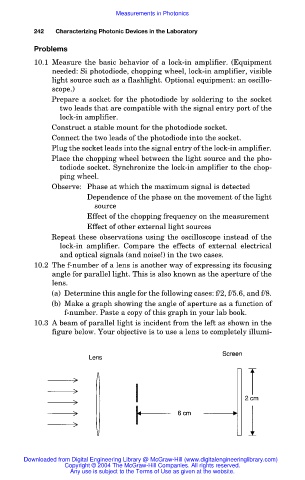
          10.3 A beam of parallel light is incident from the left as shown in the
               figure below. Your objective is to use a lens to completely illumi-


       Downloaded from Digital Engineering Library @ McGraw-Hill (www.digitalengineeringlibrary.com)
                   Copyright © 2004 The McGraw-Hill Companies. All rights reserved.
                    Any use is subject to the Terms of Use as given at the website.

