


Page 246 - Photonics Essentials an introduction with experiments
P. 246
Measurements in Photonics

          240   Characterizing Photonic Devices in the Laboratory

          10.9  Photon Detectors
          There is a choice of device for light detection: photodiodes, charge-
          coupled devices (CCDs), photomultiplier tubes, etc. We will limit our
          discussion to photodiode detectors, the most widely-used devices for
          detecting light. Photodiode detector circuits can be used in two ways:


          1. Photovoltaic mode. This means that you plug the leads into a volt-
             meter, such as the lock-in amplifier, and measure the voltage de-
             veloped by absorbing photons. No power supply is needed.
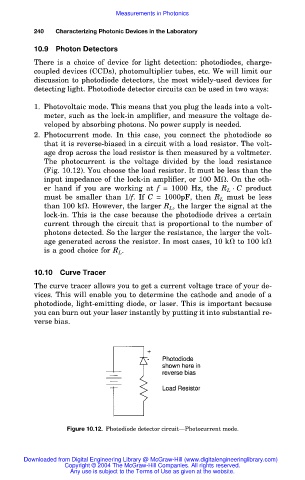
          2. Photocurrent mode. In this case, you connect the photodiode so
             that it is reverse-biased in a circuit with a load resistor. The volt-
             age drop across the load resistor is then measured by a voltmeter.
             The photocurrent is the voltage divided by the load resistance
             (Fig. 10.12). You choose the load resistor. It must be less than the
             input impedance of the lock-in amplifier, or 100 M . On the oth-
             er hand if you are working at  f = 1000 Hz, the  R · C product
                                                              L
             must be smaller than 1/f. If  C = 1000pF, then  R L must be less
             than 100 k . However, the larger R L , the larger the signal at the
             lock-in. This is the case because the photodiode drives a certain
             current through the circuit that is proportional to the number of
             photons detected. So the larger the resistance, the larger the volt-
             age generated across the resistor. In most cases, 10 k  to 100 k
             is a good choice for R L .


          10.10  Curve Tracer
          The curve tracer allows you to get a current voltage trace of your de-
          vices. This will enable you to determine the cathode and anode of a
          photodiode, light-emitting diode, or laser. This is important because
          you can burn out your laser instantly by putting it into substantial re-
          verse bias.


                   Figure 10.12. Photodiode detector circuit—Photocurrent mode.


       Downloaded from Digital Engineering Library @ McGraw-Hill (www.digitalengineeringlibrary.com)
                   Copyright © 2004 The McGraw-Hill Companies. All rights reserved.
                    Any use is subject to the Terms of Use as given at the website.

