


Page 242 - Photonics Essentials an introduction with experiments
P. 242
Measurements in Photonics

          236   Characterizing Photonic Devices in the Laboratory


             Grating                                       Entrance slit                     Mirrors

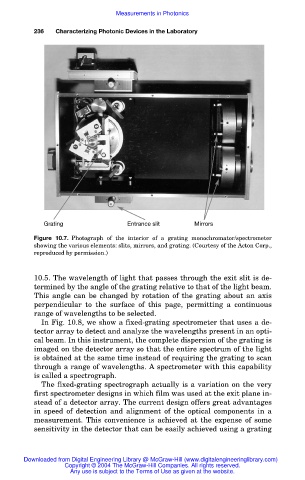
          Figure 10.7. Photograph of the interior of a grating monochromator/spectrometer
          showing the various elements: slits, mirrors, and grating. (Courtesy of the Acton Corp.,
          reproduced by permission.)


          10.5. The wavelength of light that passes through the exit slit is de-
          termined by the angle of the grating relative to that of the light beam.
          This angle can be changed by rotation of the grating about an axis
          perpendicular to the surface of this page, permitting a continuous
          range of wavelengths to be selected.
            In Fig. 10.8, we show a fixed-grating spectrometer that uses a de-
          tector array to detect and analyze the wavelengths present in an opti-
          cal beam. In this instrument, the complete dispersion of the grating is
          imaged on the detector array so that the entire spectrum of the light
          is obtained at the same time instead of requiring the grating to scan
          through a range of wavelengths. A spectrometer with this capability
          is called a spectrograph.
            The fixed-grating spectrograph actually is a variation on the very
          first spectrometer designs in which film was used at the exit plane in-
          stead of a detector array. The current design offers great advantages
          in speed of detection and alignment of the optical components in a
          measurement. This convenience is achieved at the expense of some
          sensitivity in the detector that can be easily achieved using a grating


       Downloaded from Digital Engineering Library @ McGraw-Hill (www.digitalengineeringlibrary.com)
                   Copyright © 2004 The McGraw-Hill Companies. All rights reserved.
                    Any use is subject to the Terms of Use as given at the website.

