


Page 244 - Photonics Essentials an introduction with experiments
P. 244
Measurements in Photonics

          238   Characterizing Photonic Devices in the Laboratory


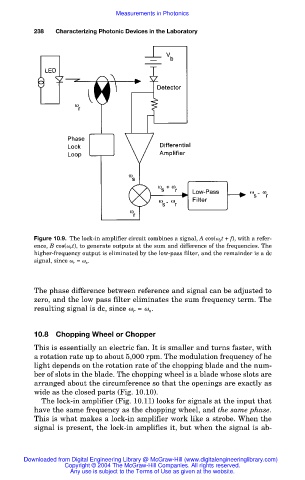
          Figure 10.9. The lock-in amplifier circuit combines a signal, A cos(  s t + f), with a refer-
          ence, B cos(  r t), to generate outputs at the sum and difference of the frequencies. The
          higher-frequency output is eliminated by the low-pass filter, and the remainder is a dc
          signal, since   r =   s .


          The phase difference between reference and signal can be adjusted to
          zero, and the low pass filter eliminates the sum frequency term. The
          resulting signal is dc, since   r =   s .


          10.8  Chopping Wheel or Chopper
          This is essentially an electric fan. It is smaller and turns faster, with
          a rotation rate up to about 5,000 rpm. The modulation frequency of he
          light depends on the rotation rate of the chopping blade and the num-
          ber of slots in the blade. The chopping wheel is a blade whose slots are
          arranged about the circumference so that the openings are exactly as
          wide as the closed parts (Fig. 10.10).
            The lock-in amplifier (Fig. 10.11) looks for signals at the input that
          have the same frequency as the chopping wheel, and the same phase.
          This is what makes a lock-in amplifier work like a strobe. When the
          signal is present, the lock-in amplifies it, but when the signal is ab-


       Downloaded from Digital Engineering Library @ McGraw-Hill (www.digitalengineeringlibrary.com)
                   Copyright © 2004 The McGraw-Hill Companies. All rights reserved.
                    Any use is subject to the Terms of Use as given at the website.

