


Page 214 - Pipelines and Risers
P. 214
Installation Design                                                   187

      Number  of  tension  machines,  the  positions  of  them  and the  capacity  is different  for each
      vessel. The last  tension  machine  is normally placed  at the  stem  of  the vessel,  close to the
      stinger.  The first  tension  machine  is  placed  somewhere  further  forward  on  the  horizontal
      ramp. The purpose of  applying tension to the pipeline through  these tension  machines is to
      control the curvature of the sagbend and the moment at the stinger tip through supporting the
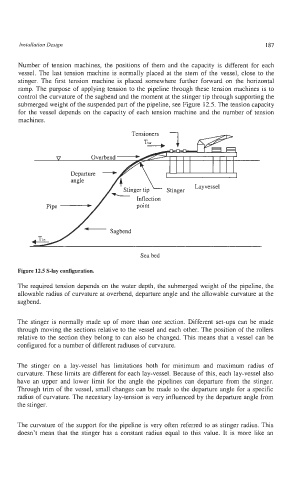
      submerged weight of the suspended part of  the pipeline, see Figure 12.5. The tension capacity
      for the vessel  depends  on the capacity of  each tension machine and the number of  tension
      machines.


                                         Sea bed

      Figure 12.5 S-lay configuration.

      The required tension depends on the water depth, the submerged weight of  the pipeline, the
      allowable radius of curvature at overbend, departure angle and the allowable curvature at the
      sagbend.

      The stinger is normally  made  up  of  more than  one section.  Different  set-ups  can be made
      through moving the sections relative to the vessel and each other. The position  of the rollers
      relative to the section they belong to can also be changed.  This means that  a vessel can be
      configured for a number of different radiuses of curvature.


      The  stinger  on  a  lay-vessel  has  limitations  both  for  minimum  and  maximum  radius  of
      curvature. These limits are different for each lay-vessel. Because of this, each lay-vessel also
      have  an  upper  and  lower  limit  for the  angle  the  pipelines  can  departure  from  the  stinger.
      Through trim of the vessel, small changes can be made to the departure angle for a specific
      radius of curvature. The necessary lay-tension is very influenced by the departure angle from
      the stinger.

      The curvature of the support for the pipeline is very often referred to as stinger radius. This
      doesn’t mean  that  the  stinger  has  a constant  radius  equal to this  value.  It  is more  like  an

