


Page 295 - Plastics Engineering
P. 295
278                                             Processing of Plastics


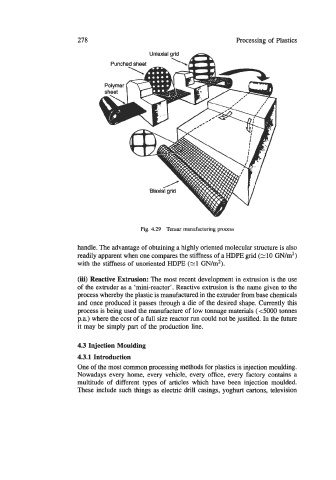
                                           Fig. 4.29  Tensar manufacturing process


                        handle. The advantage of obtaining a highly oriented molecular structure is also
                        readily apparent when one compares the stiffness of a HDPE grid (-10  GN/m2)
                        with the stiffness of unoriented HDPE (21 GN/m2).

                        (iii) Reactive Extrusion: The most recent development in extrusion is the use
                        of the extruder as a ‘mini-reactor’. Reactive extrusion is the name given to the
                        process whereby the plastic is manufactured in the extruder from base chemicals
                        and once produced it passes through a die of the desired shape. Currently this
                        process is being used the manufacture of low tonnage materials (4000 tonnes
                        p.a.) where the cost of a full size reactor run could not be justified. In the future
                        it may be simply part of the production line.

                        4.3 Injection Moulding
                        4.3.1 Introduction
                        One of the most common processing methods for plastics is injection moulding.
                        Nowadays every home, every vehicle, every office, every factory contains a
                        multitude of  different types  of  articles which  have  been  injection moulded.
                        These include such things as electric drill casings, yoghurt cartons, television

