


Page 126 - Practical Control Engineering a Guide for Engineers, Managers, and Practitioners
P. 126
A New  Do11ain  and  More  Process  Models   101


                  to 1
                                       ..             . .
               (I)
              "'0
               .a
              :.=   tOO
               Q..                     ''
               ~
                  to-I
                       to-2            to-I           to 0
                  too
              -     0
              ~
               (I)
               U)   -100                              Dead time= 8
               cu
              f
                 -200
                 -300
                       to-2                           to 0
                                     Radian frequency
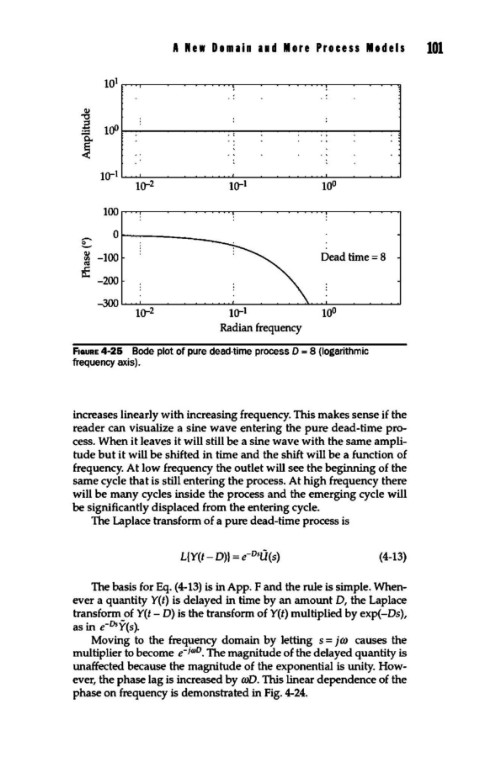
             F1GURE4-26  Bode plot of pure dead-time process D = 8 (logarithmic
             frequency axis).


             increases linearly with increasing frequency. This makes sense if the
             reader can visualize a sine wave entering the pure dead-time pro-
             cess. When it leaves it will still be a sine wave with the same ampli-
             tude but it will be shifted in time and the shift will be a function of
             frequency. At low frequency the outlet will see the beginning of the
             same cycle that is still entering the process. At high frequency there
             will be many cycles inside the process and the emerging cycle will
             be significantly displaced from the entering cycle.
                The Laplace transform of a pure dead-time process is


                               L{Y(t- D)J = e-Dszi(s)           (4-t3)

                The basis for Eq. (4-t3) is in App. F and the rule is simple. When-
             ever a quantity Y(t) is delayed in time by an amount D, the Laplace
             transform of Y(t- D) is the transform of Y(t) multiplied by exp(-Ds),
             as in  e-DsY(s).
                Moving to  the frequency  domain by letting  s = jm  causes the
             multiplier to become e-iOJD. The magnitude of the delayed quantity is
             unaffected because the magnitude of the exponential is unity. How-
             ever, the phase lag is increased by roD. This linear dependence of the
             phase on frequency is demonstrated in Fig. 4-24.

