


Page 124 - Practical Control Engineering a Guide for Engineers, Managers, and Practitioners
P. 124
A New  Do11ain  and  More  Process  Models   99


               Answer  The most phase lag that can come out of a first-order process is 90°
               and that is only at high frequencies. Proportional-only control adds no phase
               lag and integral-only adds 90° so the first-order process under integral-only or
               proportional-integral control can only have 180° phase lag as a limiting case
               when the frequency is extremely high.


        4-4  A Pure Dead-Time Process
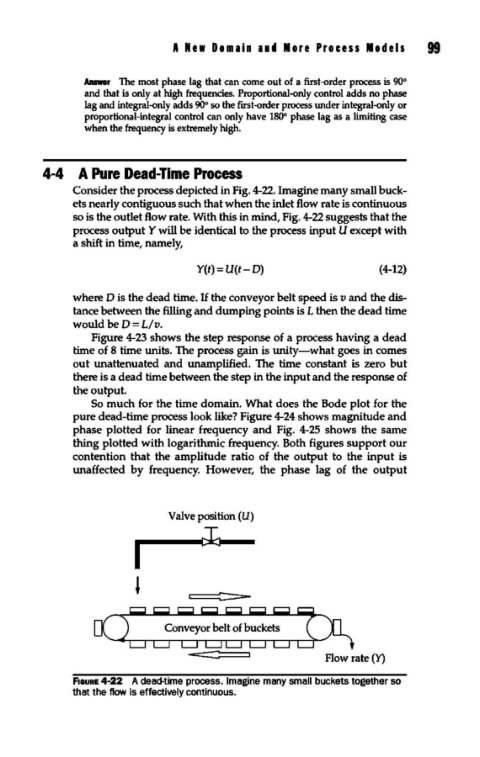
             Consider the process depicted in Fig. 4-22. Imagine many small buck-
             ets nearly contiguous such that when the inlet flow rate is continuous
             so is the outlet flow rate. With this in mind, Fig. 4-22 suggests that the
             process output Y will be identical to the process input U except with
             a shift in time, namely,
                                  Y(t) = U(t- D)                (4-12)

             where D is the dead time. If the conveyor belt speed is v and the dis-
             tance between the filling and dumping points is L then the dead time
             would beD= L/v.
                Figure 4-23 shows the step response of a process having a dead
             time of 8 time units. The process gain is unity-what goes in comes
             out unattenuated  and  unamplified.  The  time constant  is  zero but
             there is a dead time between the step in the input and the response of
             the output.
                So much for the time domain. What does the Bode plot for the
             pure dead-time process look like? Figure 4-24 shows magnitude and
             phase plotted for  linear frequency and  Fig.  4-25  shows the same
             thing plotted with logarithmic frequency. Both figures support our
             contention that the amplitude ratio of the output to  the input is
             unaffected  by  frequency.  However,  the  phase  lag  of  the  output


                             Valve position (U)
                       ~


                       '


                                                       Flow rate (Y)
             F1auRE 4-22  A dead-time process. Imagine many small buckets together so
             that the flow is effectively continuous.

