


Page 128 - Practical Control Engineering a Guide for Engineers, Managers, and Practitioners
P. 128
A New  Do11ai1  and  More  Process  Models   103


                 1.5 r---r---r---r---r---r---r---r----r----r------,

                   1
              :::s  0.5

                   0
                --O.S 0   10   20   30   40   50   60   70   80   90   100


                 1.5 --~-:--=-~----=--=-~-~===:::::c::==il
                                                         I-S ·-·Y
                   1~~~~--~--~--~---~~~-----~~~~
              V)   0           I      :j   I:         I   .j   j.   !
              ~  ~ •. J::t.J:::: ~J:::LJ:[:LU:: LJ:::L


                --O.S 0   10   20   30   40   50   60   70   80   90   100
                                         Time
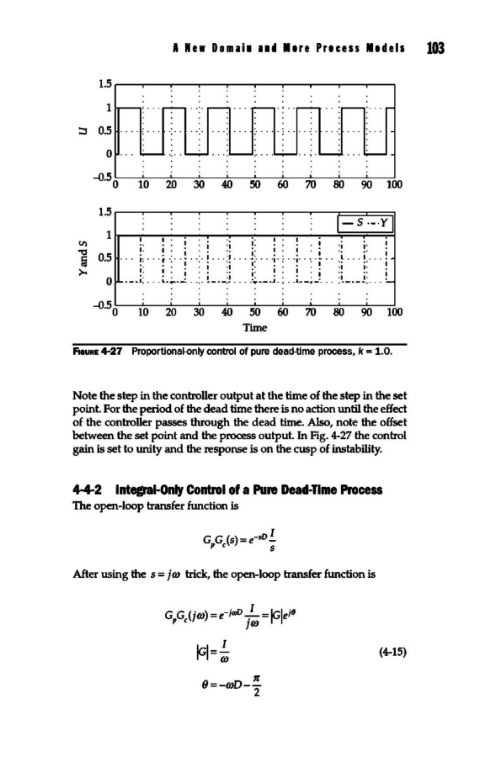
             F1auRE 4-27  Proportionakmly control of pure dead-time process, k = 1.0.


             Note the step in the controller output at the time of the step in the set
             point. For the period of the dead time there is no action until the effect
             of the controller passes through the dead time. Also, note the offset
             between the set point and the process output. In Fig. 4-27 the control
             gain is set to unity and the response is on the cusp of instability.


             4-4-2  Integral-Only Control of a Pure Dead-Time Process
             The open-loop transfer function is

                                   G G (s)=e-sD.!.
                                    p  c      s

             After using the s = jro  trick, the open-loop transfer function is


                            G G (J"ro) = e-it»D ~ = 1Giei 9
                              p  c        }(J)

                                                                (4-15)

                                  6=-roD-!!
                                           2

