


Page 129 - Practical Control Engineering a Guide for Engineers, Managers, and Practitioners
P. 129
104  Chapter  Four


                  tot


               (I)
              "0
              .a
              :.=   to 0
               Q..
              ~
                 to-t
                       to-2            to-t

                  too
              -    0
              ~
               ~ -tOO
              .!
              c..
                 -200
                 -300
                       to-2                           tOO
                                     Radian frequency
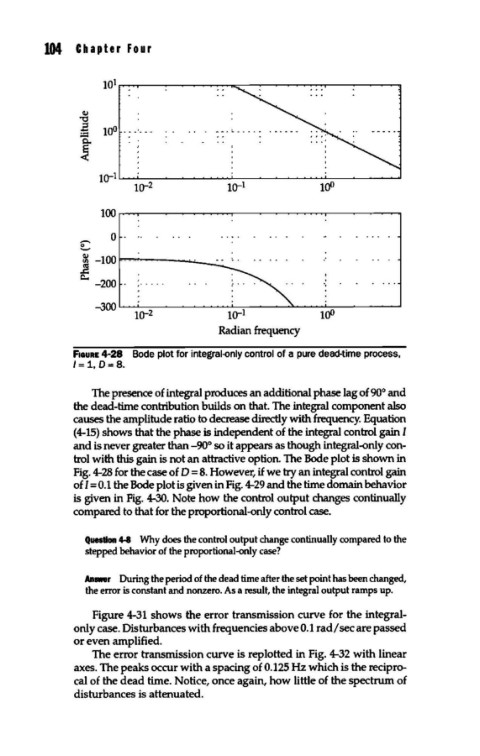
             F1auRE 4-28  Bode plot for integral-only control of a pure dead-time process,
             I= 1, 0=8.

                The presence of integral produces an additional phase lag of  90° and
             the dead-time contribution builds on that. The integral component also
             causes the amplitude ratio to decrease directly with frequency. Equation
             (4-tS) shows that the phase is independent of the integral control gain I
             and is never greater than -90° so it appears as though integral-only con-
             trol with this gain is not an attractive option. The Bode plot is shown in
             Fig. 4-28 for the case of D = 8. However, if we try an integral control gain
             of  I=  O.t the Bode plot is given in Fig. 4-29 and the time domain behavior
             is given in Fig. 4-30. Note how the control output changes continually
             compared to that for the proportional-only control case.

               Question 4-8  Why does the control output change continually compared to the
               stepped behavior of the proportional-only case?

               Answer  During the period of the dead time after the set point has been changed,
               the error is constant and nonzero. As a result, the integral output ramps up.
                Figure 4-3t shows the error transmission curve for the integral-
             only case. Disturbances with frequencies above O.t rad/  sec are passed
             or even amplified.
                The error transmission curve is replotted in Fig. 4-32 with linear
             axes. The peaks occur with a spacing of 0.125 Hz which is the recipro-
             cal of the dead time. Notice, once again, how little of the spectrum of
             disturbances is attenuated.

