


Page 169 - Pressure Vessel Design Manual
P. 169
Design of  Vessel Supports   147


                                     axis


                                                                                   I-


                                               b                                                   axis


                                                                                      L Assume as 0.8P
                                                                                        for  single gusset

                                                                                      M
                                                                                   F=-L
               e = .78a but  < 12t                                                    h
                                                         F
              F=     ~ML     COS0              At bottom f = -2                    f=-  F
                 (h + e)(h + 2e) [T]                      0                           0
                                                          Type 2                           Type 3
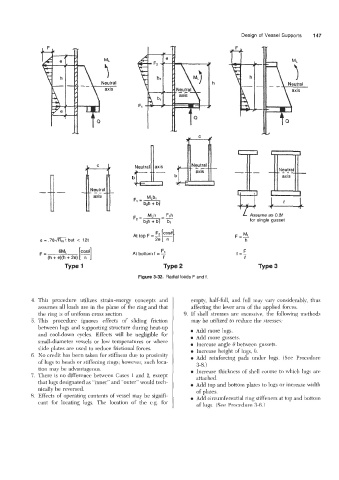
                                                 Figure 3-32.  Radial loads F and f.


            4. This  procedure  utilizes  strain-energy  concepts  and   empty,  half-full, and  f~dl may  vary  considerably,  thus
              assumes all loads are in the plane of the ring and that   affecting the lever arm of the applied forces.
              the ring is of uniform  cross section.             9.  If  shell  stresses  are excessive, the  following methods
            5. This  procedure  ignores  effects  of  sliding  friction   may be utilized to reduce the  stresses:
              between lugs and supporting structure during heat-up   0  Add more lugs.
              and  cool-down  cycles.  Effects  will  be  negligible  for   0  Add  more gussets.
              small-diameter  vessels  or low  temperatures  or where   0  Increase angle e between  gussets.
              slide plates  are used to reduce  frictional forces.   0  Increase height of lugs, 11.
            6. No credit has been taken for stiffness due to proximity
              of lugs to heads or stiffening rings; however, such loca-   Add  reinforcing  pads  under  lugs.  (See Procedure
                                                                     3-8.)
              tion may be advantageous.
            7.  There is no difference between  Cases  1 and 2, except   0  Increase thickness of  she11 course to which lugs  are
              that lugs designated as “inner” and “outer” would tech-   attached .
              nically be reversed.                                  0  Add top and bottom plates to lugs or increase width
                                                                     of plates.
            8.  Effects  of  operating contents  of vessel may  be  signifi-   0  Add circumferential ring stiffeners at top and bottom
              cant  for  locating  lugs.  The  location  of  the  c.g.  for
                                                                      of lugs. (See Procedure  3-6.)

