


Page 204 - Pressure Vessel Design Manual
P. 204
182    Pressure Vessel Design Manual

                             Anchor Bolts

             Anchor bolts are governed by one of the three following
           load cases:
              1. Longitudinal load: If Qo > QL, then no uplift occurs,
                and the  minimum number  and  size of  anchor bolts
                should be used.
                If Qo  < QL, then uplift does occur:


                QL  - Qo  = load per bolt
                .N
              2.  Shear: Assume the fNed saddle takes the entire shear
                load.

                FL
                - = shear per bolt
                N
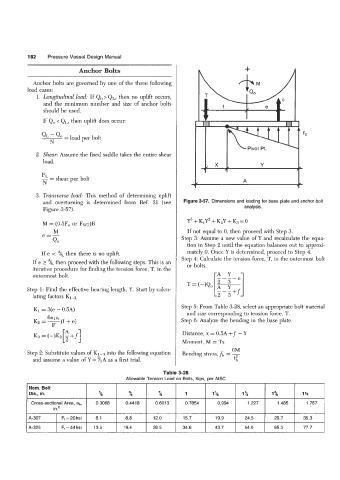
              3.  Transverse load: This method  of  determining uplift
                and  overturning  is  determined  from  Ref.  21  (see   Figure 3-57.  Dimensions and loading for base plate and anchor bolt
                Figure 3-57).                                                          analysis.

                M = (0.5Fe or Fw)B                                 Y3 + K,Y2 + KzY + K3 = 0
                    M                                              If not equal to 0, then proceed with Step 3.
                e=-                                              Step 3: Assume a new value of Y and recalculate the equa-
                    Qo
                                                                   tion in Step 2 until the equation balances out to approxi-
                If e < "/6, then there is no uplift.               mately 0. Once Y is determined, proceed to Step 4.
                                                                 Step 4: Calculate the tension force, T, in the outermost bolt
             If e 3 %, then proceed with the following steps. This is an   or bolts.
             iterative procedure for finding the tension force, T, in the
             outermost bolt.                                                 I-A   Y   1

           Step 1: Find the effective bearing length, Y. Start by calcu-
             lating factors K1a,

                                                                 Step 5: From Table 3-28, select an appropriate bolt material
             Ki = 3(e - 0.5A)                                      and size corresponding to tension-force, T.
                  6nlat
                       (f + e)
             Kz  = -                                             Step 6: Analyze the bending in the base plate.
                   F
                                                                 Distance, x = 0.5A +f  - Y
                                                                 Moment, M = Tx
                                                                                   6M
           Step 2: Substitute values of K1-3  into the following equation   Bending stress,fb = -
             and assume a value of Y = %A as a first trial.                        t"b


                                             Allowable Tension Load on Bolts, Kips, per AlSC
           ~  Nom. Bolt
           Dia.,  in.               %         t          2l       1         1%        1%         1%         1 'h
            Cross-sectional Area, ab,   0.3068   0.441 8   0.6013   0.7854    0.994     1.227      1.485     1.767
                    in.'

           A-307       Ft=20ksi    6.1       8.8       12.0       15.7       19.9      24.5       29.7      35.3
           A-325       Ft=44ksi   13.5       19.4      26.5      34.6        43.7      54.0       65.3      77.7

