


Page 308 - Rashid, Power Electronics Handbook
P. 308
298 S. Hui and H. Chung
L L
dc dc
D2 D2
T2 T2
T1 C T1 C
Vdc I Vdc I
L r O L r O
r r
C dc C dc
D1 D1
T3 T3
(a) normal mode (b) mode 1
L L
dc dc
D2 D2
T2 T2
T1 C T1 C
Vdc I Vdc I
L r O L r O
r r
C C
dc dc
D1 D1
T3 T3
(c) mode 2 (d) mode 3
L L
dc dc
D2 D2
T2 T2
T1 C T1 C
Vdc I Vdc I
L r O L r O
r r
C C
dc dc
D1 D1
T3 T3
(e) mode 4 (f) mode 5
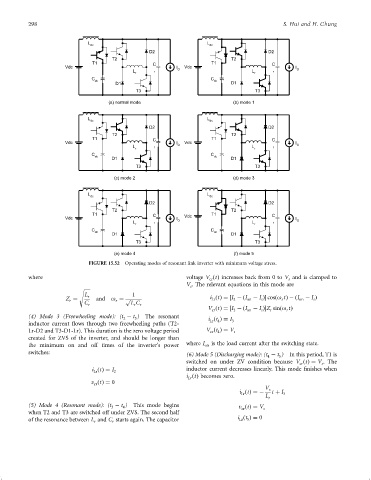
FIGURE 15.52 Operating modes of resonant link inverter with minimum voltage stress.
where voltage V ðtÞ increases back from 0 to V and is clamped to
cr
s
V . The relevant equations in this mode are
s
s
L r 1
Z ¼ and o ¼ p i ðtÞ¼ I ÿðI on ÿ I Þ cosðo tÞÿðI on ÿ I Þ
Lr
r
s
2
s
r
r
C L C
r r r
V ðtÞ¼ I ÿðI ÿ I ÞZ sinðo tÞ
cr 2 on s r r
(4) Mode 3 (Freewheeling mode): (t ÿ t ) The resonant i ðt Þ¼ I
3
2
inductor current ¯ows through two freewheeling paths (T2- Lr 4 3
Lr-D2 and T3-D1-Lr). This duration is the zero voltage period V ðt Þ¼ V s
cr 4
created for ZVS of the inverter, and should be longer than
the minimum on and off times of the inverter's power where I on is the load current after the switching state.
switches: (6) Mode 5 (Discharging mode): (t ÿ t ) In this period, T1 is
4 5
switched on under ZV condition because V ðtÞ¼ V . The
cr s
i ðtÞ¼ I inductor current decreases linearly. This mode ®nishes when
Lr 2
i ðtÞ becomes zero.
Lr
v ðtÞ¼ 0
cr
V s
i ðtÞ¼ ÿ t þ I
Lr 3
L
r
(5) Mode 4 (Resonant mode): (t ÿ t ) This mode begins v ðtÞ¼ V s
4
3
cr
when T2 and T3 are switched off under ZVS. The second half
of the resonance between L and C starts again. The capacitor i ðt Þ¼ 0
Lr 5
r
r

