


Page 212 - Robot Builders Source Book - Gordon McComb
P. 212
200                            Feedback Sensors

        5.4 Temperature Sensors

           We consider three groups of phenomena used in the design of temperature sensors:

            1. Electrical phenomena,
           2. Thermal expansion,
           3. Optical phenomena.
           1. Electrical sensors are based mainly on thermoresistors and thermocouples. In
        addition, an electroacoustic method, based on the dependence of the speed of sound
        upon gas temperature, and a thermonoise method are in use.
                                                                     1
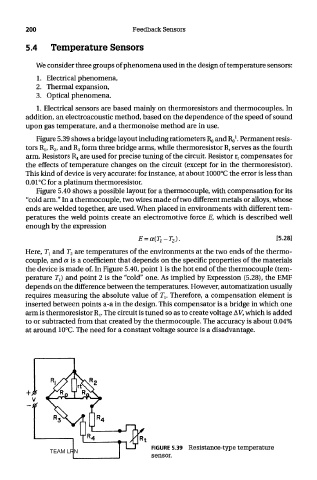
           Figure 5.39 shows a bridge layout including ratiometers RQ and Ro . Permanent resis-
        tors R lf R 2, and R 3 form three bridge arms, while thermoresistor R t serves as the fourth
        arm. Resistors R 4 are used for precise tuning of the circuit. Resistor r t compensates for
        the effects of temperature changes on the circuit (except for in the thermoresistor).
        This kind of device is very accurate: for instance, at about 1000°C the error is less than
        0.01°C for a platinum thermoresistor.
           Figure 5.40 shows a possible layout for a thermocouple, with compensation for its
        "cold arm." In a thermocouple, two wires made of two different metals or alloys, whose
        ends are welded together, are used. When placed in environments with different tem-
        peratures the weld points create an electromotive force E, which is described well
        enough by the expression


        Here, 7\ and T 2 are temperatures of the environments at the two ends of the thermo-
        couple, and a is a coefficient that depends on the specific properties of the materials
        the device is made of. In Figure 5.40, point 1 is the hot end of the thermocouple (tem-
        perature 7\) and point 2 is the "cold" one. As implied by Expression (5.28), the EMF
        depends on the difference between the temperatures. However, automatization usually
        requires measuring the absolute value of 7\. Therefore, a compensation element is
        inserted between points a-a in the design. This compensator is a bridge in which one
        arm is thermoresistor R t. The circuit is tuned so as to create voltage AV, which is added
        to or subtracted from that created by the thermocouple. The accuracy is about 0.04%
        at around 10°C. The need for a constant voltage source is a disadvantage.


                                             FIGURE 5.39 Resistance-type temperature
               TEAM LRN
                                             sensor.

