


Page 213 - Robot Builders Source Book - Gordon McComb
P. 213
202                            Feedback Sensors

        in volume. This pressure is transmitted through thin pipe 2 to pressure sensor 3 of, say,
        a membrane type. The deformation of this membrane is transformed by a displace-
        ment sensor into a useful signal.
           3. Temperature measurements can also be made by a noncontact optical (pyrom-
        eter) method based on the fact that, for an absolute black body, the radiant energy E
        depends on its temperature, as follows:


        where a is constant.

           Measuring this energy allows estimation of the temperature of the radiating body.
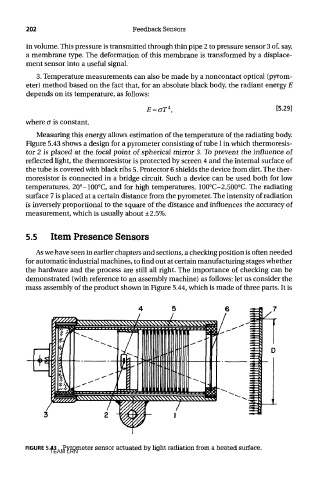
        Figure 5.43 shows a design for a pyrometer consisting of tube 1 in which thermoresis-
        tor 2 is placed at the focal point of spherical mirror 3. To prevent the influence of
        reflected light, the thermoresistor is protected by screen 4 and the internal surface of
        the tube is covered with black ribs 5. Protector 6 shields the device from dirt. The ther-
        moresistor is connected in a bridge circuit. Such a device can be used both for low
        temperatures, 20°-100°C, and for high temperatures, 100°C-2,500°C. The radiating
        surface 7 is placed at a certain distance from the pyrometer. The intensity of radiation
        is inversely proportional to the square of the distance and influences the accuracy of
        measurement, which is usually about ±2.5%.


         5.5    Item Presence Sensors

           As we have seen in earlier chapters and sections, a checking position is often needed
        for automatic industrial machines, to find out at certain manufacturing stages whether
        the hardware and the process are still all right. The importance of checking can be
         demonstrated (with reference to an assembly machine) as follows: let us consider the
        mass assembly of the product shown in Figure 5.44, which is made of three parts. It is


         FIGURE 5.43 Pyrometer sensor actuated by light radiation from a heated surface.
               TEAM LRN

