


Page 27 - Robotics Designing the Mechanisms for Automated Machinery
P. 27
16            Introduction: Brief Historical Review and Main Definitions


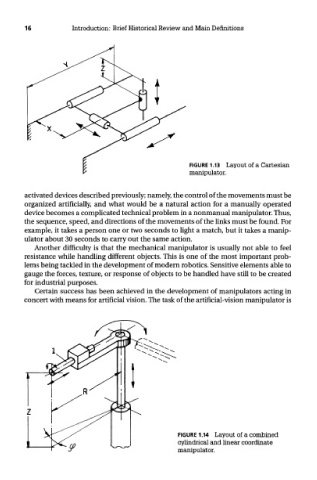
                                                       FIGURE 1.13 Layout of a Cartesian
                                                       manipulator.


        activated devices described previously; namely, the control of the movements must be
        organized artificially, and what would be a natural action for a manually operated
        device becomes a complicated technical problem in a nonmanual manipulator. Thus,
        the sequence, speed, and directions of the movements of the links must be found. For
        example, it takes a person one or two seconds to light a match, but it takes a manip-
        ulator about 30 seconds to carry out the same action.
           Another difficulty is that the mechanical manipulator is usually not able to feel
        resistance while handling different objects. This is one of the most important prob-
        lems being tackled in the development of modern robotics. Sensitive elements able to
        gauge the forces, texture, or response of objects to be handled have still to be created
        for industrial purposes.
           Certain success has been achieved in the development of manipulators acting in
        concert with means for artificial vision. The task of the artificial-vision manipulator is


                                                    FIGURE 1.14 Layout of a combined
                                                    cylindrical and linear coordinate
                                                    manipulator.

