


Page 107 - Semiconductor Manufacturing Handbook
P. 107
Geng(SMH)_CH09.qxd  04/04/2005  19:42  Page 9.6


                                                     MICROLITHOGRAPHY

                   9.6  WAFER PROCESSING


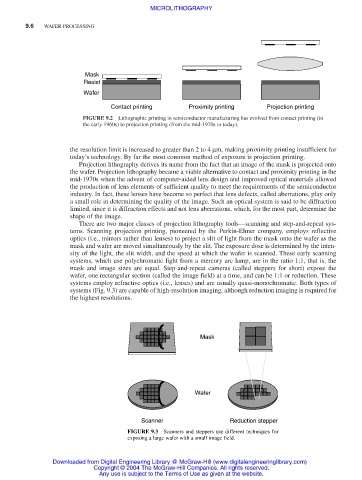
                                   Mask
                                   Resist
                                   Wafer
                                          Contact printing     Proximity printing   Projection printing
                                  FIGURE 9.2  Lithographic printing in semiconductor manufacturing has evolved from contact printing (in
                                  the early 1960s) to projection printing (from the mid-1970s to today).


                               the resolution limit is increased to greater than 2 to 4 µm, making proximity printing insufficient for
                               today’s technology. By far the most common method of exposure is projection printing.
                                 Projection lithography derives its name from the fact that an image of the mask is projected onto
                               the wafer. Projection lithography became a viable alternative to contact and proximity printing in the
                               mid-1970s when the advent of computer-aided lens design and improved optical materials allowed
                               the production of lens elements of sufficient quality to meet the requirements of the semiconductor
                               industry. In fact, these lenses have become so perfect that lens defects, called aberrations, play only
                               a small role in determining the quality of the image. Such an optical system is said to be diffraction
                               limited, since it is diffraction effects and not lens aberrations, which, for the most part, determine the
                               shape of the image.
                                 There are two major classes of projection lithography tools—scanning and step-and-repeat sys-
                               tems. Scanning projection printing, pioneered by the Perkin-Elmer company, employs reflective
                               optics (i.e., mirrors rather than lenses) to project a slit of light from the mask onto the wafer as the
                               mask and wafer are moved simultaneously by the slit. The exposure dose is determined by the inten-
                               sity of the light, the slit width, and the speed at which the wafer is scanned. These early scanning
                               systems, which use polychromatic light from a mercury arc lamp, are in the ratio 1:1, that is, the
                               mask and image sizes are equal. Step-and-repeat cameras (called steppers for short) expose the
                               wafer, one rectangular section (called the image field) at a time, and can be 1:1 or reduction. These
                               systems employ refractive optics (i.e., lenses) and are usually quasi-monochromatic. Both types of
                               systems (Fig. 9.3) are capable of high-resolution imaging, although reduction imaging is required for
                               the highest resolutions.


                                                                  Mask


                                                                 Wafer


                                                  Scanner                 Reduction stepper
                                               FIGURE 9.3  Scanners and steppers use different techniques for
                                               exposing a large wafer with a small image field.


                          Downloaded from Digital Engineering Library @ McGraw-Hill (www.digitalengineeringlibrary.com)
                                     Copyright © 2004 The McGraw-Hill Companies. All rights reserved.
                                       Any use is subject to the Terms of Use as given at the website.

