


Page 121 - Semiconductor Manufacturing Handbook
P. 121
Geng(SMH)_CH09.qxd  04/04/2005  19:42  Page 9.20


                                                     MICROLITHOGRAPHY

                   9.20  WAFER PROCESSING


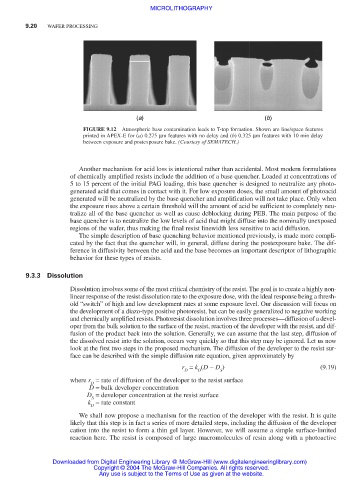
                                                 (a)                                (b)
                                   FIGURE 9.12  Atmospheric base contamination leads to T-top formation. Shown are line/space features
                                   printed in APEX-E for (a) 0.275 µm features with no delay and (b) 0.325 µm features with 10 min delay
                                   between exposure and postexposure bake. (Courtesy of SEMATECH.)


                                 Another mechanism for acid loss is intentional rather than accidental. Most modern formulations
                               of chemically amplified resists include the addition of a base quencher. Loaded at concentrations of
                               5 to 15 percent of the initial PAG loading, this base quencher is designed to neutralize any photo-
                               generated acid that comes in contact with it. For low exposure doses, the small amount of photoacid
                               generated will be neutralized by the base quencher and amplification will not take place. Only when
                               the exposure rises above a certain threshold will the amount of acid be sufficient to completely neu-
                               tralize all of the base quencher as well as cause deblocking during PEB. The main purpose of the
                               base quencher is to neutralize the low levels of acid that might diffuse into the nominally unexposed
                               regions of the wafer, thus making the final resist linewidth less sensitive to acid diffusion.
                                 The simple description of base quenching behavior mentioned previously, is made more compli-
                               cated by the fact that the quencher will, in general, diffuse during the postexposure bake. The dif-
                               ference in diffusivity between the acid and the base becomes an important descriptor of lithographic
                               behavior for these types of resists.

                   9.3.3 Dissolution

                               Dissolution involves some of the most critical chemistry of the resist. The goal is to create a highly non-
                               linear response of the resist dissolution rate to the exposure dose, with the ideal response being a thresh-
                               old “switch” of high and low development rates at some exposure level. Our discussion will focus on
                               the development of a diazo-type positive photoresist, but can be easily generalized to negative working
                               and chemically amplified resists. Photoresist dissolution involves three processes—diffusion of a devel-
                               oper from the bulk solution to the surface of the resist, reaction of the developer with the resist, and dif-
                               fusion of the product back into the solution. Generally, we can assume that the last step, diffusion of
                               the dissolved resist into the solution, occurs very quickly so that this step may be ignored. Let us now
                               look at the first two steps in the proposed mechanism. The diffusion of the developer to the resist sur-
                               face can be described with the simple diffusion rate equation, given approximately by
                                                             r = k (D − D )                        (9.19)
                                                              D   D     S
                               where r = rate of diffusion of the developer to the resist surface
                                     D
                                    D = bulk developer concentration
                                    D = developer concentration at the resist surface
                                     S
                                    k = rate constant
                                     D
                                 We shall now propose a mechanism for the reaction of the developer with the resist. It is quite
                               likely that this step is in fact a series of more detailed steps, including the diffusion of the developer
                               cation into the resist to form a thin gel layer. However, we will assume a simple surface-limited
                               reaction here. The resist is composed of large macromolecules of resin along with a photoactive


                          Downloaded from Digital Engineering Library @ McGraw-Hill (www.digitalengineeringlibrary.com)
                                     Copyright © 2004 The McGraw-Hill Companies. All rights reserved.
                                       Any use is subject to the Terms of Use as given at the website.

