


Page 118 - Semiconductor Manufacturing Handbook
P. 118
Geng(SMH)_CH09.qxd  04/04/2005  19:42  Page 9.17


                                                        MICROLITHOGRAPHY

                                                                                      MICROLITHOGRAPHY  9.17

                                           1.6

                                           1.4

                                           1.2
                                          Relative intensity  0.8 1


                                           0.6

                                           0.4
                                           0.2

                                            0
                                              0        200        400       600       800       1000
                                                                Depth into resist (nm)
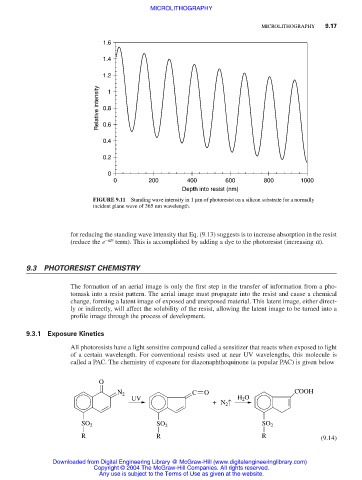
                                        FIGURE 9.11  Standing wave intensity in 1 µm of photoresist on a silicon substrate for a normally
                                        incident plane wave of 365 nm wavelength.


                                  for reducing the standing wave intensity that Eq. (9.13) suggests is to increase absorption in the resist
                                  (reduce the e −aD  term). This is accomplished by adding a dye to the photoresist (increasing a).


                      9.3 PHOTORESIST CHEMISTRY

                                  The formation of an aerial image is only the first step in the transfer of information from a pho-
                                  tomask into a resist pattern. The aerial image must propagate into the resist and cause a chemical
                                  change, forming a latent image of exposed and unexposed material. This latent image, either direct-
                                  ly or indirectly, will affect the solubility of the resist, allowing the latent image to be turned into a
                                  profile image through the process of development.

                      9.3.1 Exposure Kinetics
                                  All photoresists have a light sensitive compound called a sensitizer that reacts when exposed to light
                                  of a certain wavelength. For conventional resists used at near UV wavelengths, this molecule is
                                  called a PAC. The chemistry of exposure for diazonaphthoquinone (a popular PAC) is given below

                                          O
                                               N 2                 C  O                        COOH
                                                   UV                          H O
                                                                                2
                                                                        +   N 2
                                     SO 2                SO 2                         SO 2

                                     R                   R                            R               (9.14)


                             Downloaded from Digital Engineering Library @ McGraw-Hill (www.digitalengineeringlibrary.com)
                                        Copyright © 2004 The McGraw-Hill Companies. All rights reserved.
                                          Any use is subject to the Terms of Use as given at the website.

