


Page 113 - Semiconductor Manufacturing Handbook
P. 113
Geng(SMH)_CH09.qxd 04/04/2005 19:42 Page 9.12
MICROLITHOGRAPHY
9.12 WAFER PROCESSING
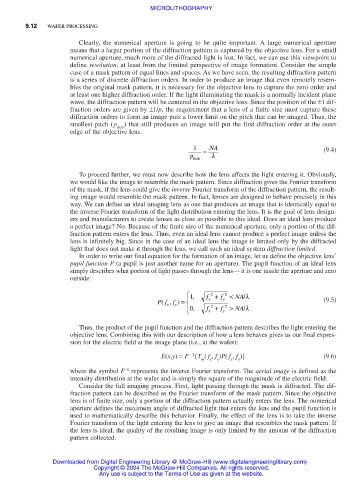
Clearly, the numerical aperture is going to be quite important. A large numerical aperture
means that a larger portion of the diffraction pattern is captured by the objective lens. For a small
numerical aperture, much more of the diffracted light is lost. In fact, we can use this viewpoint to
define resolution, at least from the limited perspective of image formation. Consider the simple
case of a mask pattern of equal lines and spaces. As we have seen, the resulting diffraction pattern
is a series of discrete diffraction orders. In order to produce an image that even remotely resem-
bles the original mask pattern, it is necessary for the objective lens to capture the zero order and
at least one higher diffraction order. If the light illuminating the mask is a normally incident plane
wave, the diffraction pattern will be centered in the objective lens. Since the position of the ±1 dif-
fraction orders are given by ±1/p, the requirement that a lens of a finite size must capture these
diffraction orders to form an image puts a lower limit on the pitch that can be imaged. Thus, the
smallest pitch (p ) that still produces an image will put the first diffraction order at the outer
min
edge of the objective lens.
1 = NA (9.4)
p min λ
To proceed further, we must now describe how the lens affects the light entering it. Obviously,
we would like the image to resemble the mask pattern. Since diffraction gives the Fourier transform
of the mask, if the lens could give the inverse Fourier transform of the diffraction pattern, the result-
ing image would resemble the mask pattern. In fact, lenses are designed to behave precisely in this
way. We can define an ideal imaging lens as one that produces an image that is identically equal to
the inverse Fourier transform of the light distribution entering the lens. It is the goal of lens design-
ers and manufacturers to create lenses as close as possible to this ideal. Does an ideal lens produce
a perfect image? No. Because of the finite size of the numerical aperture, only a portion of the dif-
fraction pattern enters the lens. Thus, even an ideal lens cannot produce a perfect image unless the
lens is infinitely big. Since in the case of an ideal lens the image is limited only by the diffracted
light that does not make it through the lens, we call such an ideal system diffraction limited.
In order to write our final equation for the formation of an image, let us define the objective lens’
pupil function P (a pupil is just another name for an aperture). The pupil function of an ideal lens
simply describes what portion of light passes through the lens— it is one inside the aperture and zero
outside:
, 1 f + f 2 < NA/l
2
Pf f ) = x y (9.5)
(,
x y 2 2
, 0 f + f y > NA/l
x
Thus, the product of the pupil function and the diffraction pattern describes the light entering the
objective lens. Combining this with our description of how a lens behaves gives us our final expres-
sion for the electric field at the image plane (i.e., at the wafer):
−1
E(x,y) = F {T ( f , f )P( f , f )} (9.6)
m x y x y
where the symbol F −1 represents the inverse Fourier transform. The aerial image is defined as the
intensity distribution at the wafer and is simply the square of the magnitude of the electric field.
Consider the full imaging process. First, light passing through the mask is diffracted. The dif-
fraction pattern can be described as the Fourier transform of the mask pattern. Since the objective
lens is of finite size, only a portion of the diffraction pattern actually enters the lens. The numerical
aperture defines the maximum angle of diffracted light that enters the lens and the pupil function is
used to mathematically describe this behavior. Finally, the effect of the lens is to take the inverse
Fourier transform of the light entering the lens to give an image that resembles the mask pattern. If
the lens is ideal, the quality of the resulting image is only limited by the amount of the diffraction
pattern collected.
Downloaded from Digital Engineering Library @ McGraw-Hill (www.digitalengineeringlibrary.com)
Copyright © 2004 The McGraw-Hill Companies. All rights reserved.
Any use is subject to the Terms of Use as given at the website.

