


Page 122 - Semiconductor Manufacturing Handbook
P. 122
Geng(SMH)_CH09.qxd  04/04/2005  19:42  Page 9.21


                                                        MICROLITHOGRAPHY

                                                                                      MICROLITHOGRAPHY  9.21

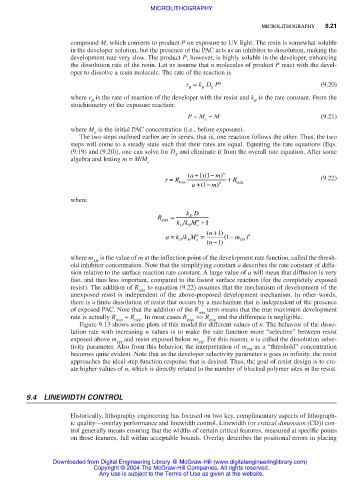
                                  compound M, which converts to product P on exposure to UV light. The resin is somewhat soluble
                                  in the developer solution, but the presence of the PAC acts as an inhibitor to dissolution, making the
                                  development rate very slow. The product P, however, is highly soluble in the developer, enhancing
                                  the dissolution rate of the resin. Let us assume that n molecules of product P react with the devel-
                                  oper to dissolve a resin molecule. The rate of the reaction is
                                                                 r = k D P n                          (9.20)
                                                                  R   R  S
                                  where r is the rate of reaction of the developer with the resist and k is the rate constant. From the
                                        R                                           R
                                  stoichiometry of the exposure reaction:
                                                                  P = M − M                           (9.21)
                                                                      o
                                  where M is the initial PAC concentration (i.e., before exposure).
                                        o
                                    The two steps outlined earlier are in series, that is, one reaction follows the other. Thus, the two
                                  steps will come to a steady state such that their rates are equal. Equating the rate equations (Eqs.
                                  (9.19) and (9.20)), one can solve for D and eliminate it from the overall rate equation. After some
                                                              S
                                  algebra and letting m = M/M
                                                       o
                                                            r =  R  ( a + )(11 − m) n  +  R           (9.22)
                                                                   a +−  m) n  min
                                                               max
                                                                     (1
                                  where
                                                                  D
                                                          R max  =  kD
                                                                    n
                                                                /
                                                               kk M +1
                                                                  R
                                                                    o
                                                                D
                                                            a =  k k M =  n ( +1 )  ( −  m ) n
                                                                    n
                                                                /
                                                                            1
                                                               D  R  o          TH
                                                                       n ( −1 )
                                  where m  is the value of m at the inflection point of the development rate function, called the thresh-
                                        TH
                                  old inhibitor concentration. Note that the simplifying constant a describes the rate constant of diffu-
                                  sion relative to the surface reaction rate constant. A large value of a will mean that diffusion is very
                                  fast, and thus less important, compared to the fastest surface reaction (for the completely exposed
                                  resist). The addition of R  to equation (9.22) assumes that the mechanism of development of the
                                                    min
                                  unexposed resist is independent of the above-proposed development mechanism. In other words,
                                  there is a finite dissolution of resist that occurs by a mechanism that is independent of the presence
                                  of exposed PAC. Note that the addition of the R  term means that the true maximum development
                                                                     min
                                  rate is actually R  + R  . In most cases R  >> R  and the difference is negligible.
                                              max  min           max    min
                                    Figure 9.13 shows some plots of this model for different values of n. The behavior of the disso-
                                  lution rate with increasing n values is to make the rate function more “selective” between resist
                                  exposed above m  and resist exposed below m . For this reason, n is called the dissolution selec-
                                               TH                    TH
                                  tivity parameter. Also from this behavior, the interpretation of m  as a “threshold” concentration
                                                                                  TH
                                  becomes quite evident. Note that as the developer selectivity parameter n goes to infinity, the resist
                                  approaches the ideal step function response that is desired. Thus, the goal of resist design is to cre-
                                  ate higher values of n, which is directly related to the number of blocked polymer sites in the resist.
                      9.4 LINEWIDTH CONTROL
                                  Historically, lithography engineering has focused on two key, complimentary aspects of lithograph-
                                  ic quality—overlay performance and linewidth control. Linewidth (or critical dimension (CD)) con-
                                  trol generally means ensuring that the widths of certain critical features, measured at specific points
                                  on those features, fall within acceptable bounds. Overlay describes the positional errors in placing
                             Downloaded from Digital Engineering Library @ McGraw-Hill (www.digitalengineeringlibrary.com)
                                        Copyright © 2004 The McGraw-Hill Companies. All rights reserved.
                                          Any use is subject to the Terms of Use as given at the website.

